
Authored by Mason Rashtian | Personal Injury Lawyer, The Mason Law Firm
Dedicated Personal Injury Lawyer in Santa Clarita, Valencia, Canyon Country, Newhall, Saugus, Stevenson Ranch, Castaic, Val Verde, Antelope Valley, Palmdale, Lancaster, the San Fernando Valley, and the Greater Los Angeles Area
A Common But Serious Scenario
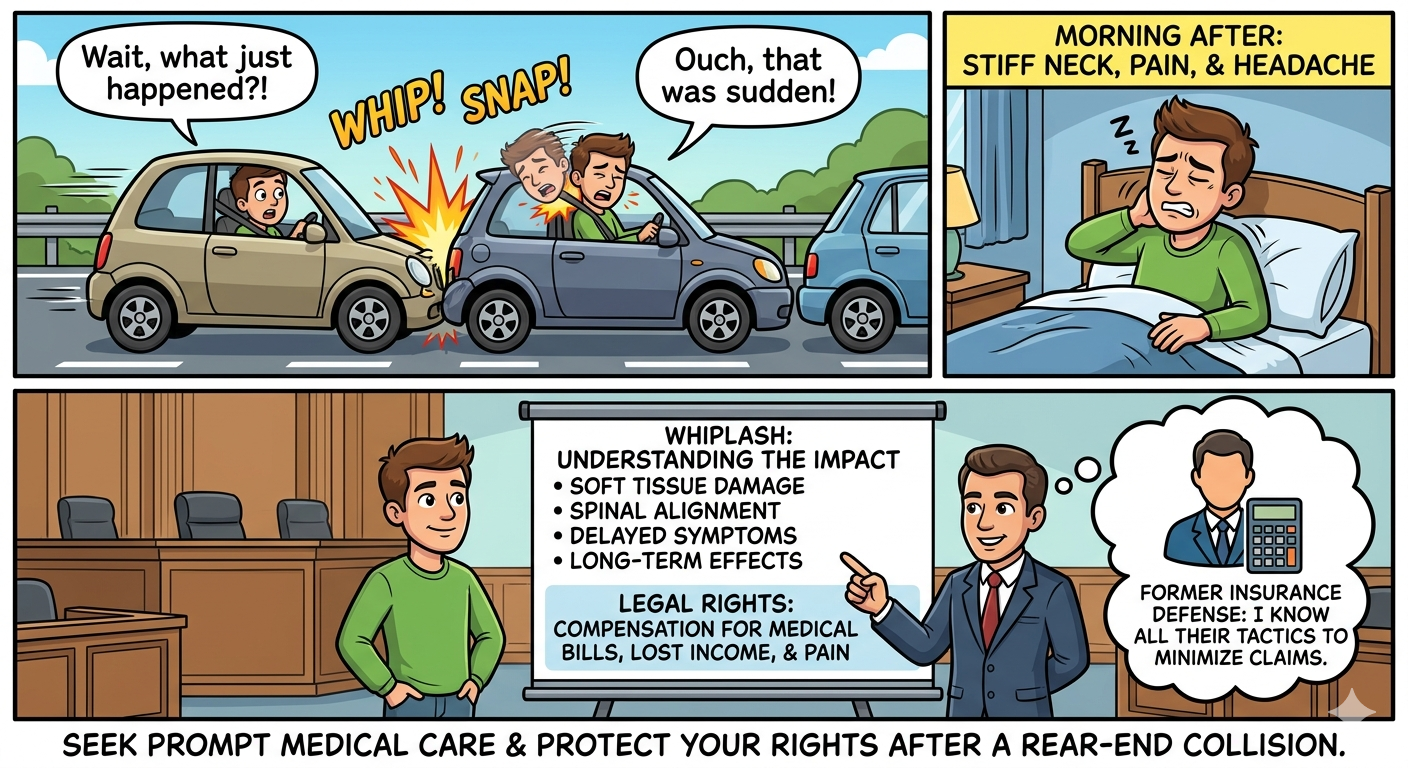
Picture this: It is a normal weekday morning, and you are driving to work. Traffic on the freeway begins to slow and eventually comes to a complete stop. So, you bring your vehicle to a stop behind the cars in front of you, just as any responsible driver would do.
Then, without any warning whatsoever, you are violently struck from behind by a driver who was either distracted, fatigued, driving too closely, or traveling well above a safe speed for traffic conditions.
The force of the impact is so severe that your vehicle is launched forward and pushed into the car directly in front of you.
So, in a matter of seconds, you have absorbed two separate and distinct impacts, one from behind and one from the front. Your body, restrained by a seatbelt, is whipped backward and then thrown forward with tremendous force.
In the immediate aftermath, the adrenaline coursing through your body masks much of what your body has just endured. You step out of your car, check your damage, and exchange insurance and contact information with the other drivers involved.
You feel composed enough to give a statement to the California Highway Patrol officer who comes to the scene. You go to work. You come home, have dinner, and go to bed feeling, by all outward appearances, completely fine.
But when you wake up the next morning, everything has changed. You can barely lift your head off the pillow. Your neck is stiff and aching. You also have a dull but persistent headache.
Your shoulders feel sore, and you notice a faint tingling sensation running down your arms. What you are experiencing is whiplash, and it is far more serious than many accident victims initially realize.
Call The Mason Law Firm, managed by Santa Clarita Personal Injury Attorney Mason Rashtian, today at 661-506-2992 for a FREE consultation. We serve clients throughout Santa Clarita, Valencia, Newhall, Saugus, Canyon Country, Stevenson Ranch, Castaic, Val Verde and all of Los Angeles County.
Statistics On Rear-end Collisions and Whiplash Injuries
According to the National Library of Medicine, research on minor rear-end accidents found occupants suffered cervical spine (neck) complaints even at average collision speed changes of only about 6.3 km/h (3.9 mph).
The National Highway Traffic Safety Administration (NHTSA) has also gathered the following crash statistics on whiplash litigation and biomechanics analysis:
| Statistic | Value |
|---|---|
| Rear-end crashes as share of all crashes | Approximately 28–29% |
| Rear-end crashes as share of two-vehicle crashes | Approximately 41% |
| Annual rear-end crashes in U.S. | Approximately 1.1–1.7 million |
| Common injury in rear-end crashes | Neck/whiplash injuries |
What Is Whiplash?
Whiplash is a painful and potentially debilitating neck injury caused by the sudden, forceful backward and forward movement of the neck and head. It is most commonly associated with rear-end car accidents, though it can also result from sports injuries, physical altercations, falls, or any high-impact event that causes the head to jerk rapidly and violently in opposite directions.
To understand why whiplash is so damaging, it helps to understand the mechanics of the injury. During a rear-end collision, the body is abruptly propelled forward by the force of impact while the head, due to its weight and inertia, momentarily lags behind.
This creates a violent snapping or whipping motion in the neck, one that the human body is simply not designed to withstand. The cervical spine (neck) and surrounding soft tissues are subjected to forces far beyond what they would experience under normal circumstances.
This sudden and extreme movement places enormous stress on the muscles, tendons, ligaments, and intervertebral discs that support the neck and head.
In many cases, these structures are stretched, strained, or torn. In more severe cases, nerve damage may occur, and the natural curvature of the cervical spine may be compromised. The result is an injury that can range from short-term discomfort to a chronic, life-altering condition requiring prolonged medical treatment.
What Are the Common Symptoms of Whiplash? They Include:
– Neck pain and stiffness, often severe enough to significantly restrict movement
– Persistent headaches, particularly at the base of the skull
– Shoulder and upper back pain
– Dizziness and difficulty with balance
– Fatigue and difficulty concentrating
– Tingling, numbness, or weakness in the arms or hands
– In some cases, cognitive difficulties often referred to as “brain fog”
One of the most important things to understand about whiplash is that symptoms frequently do not appear immediately following the accident.
As described in the scenario above, it is entirely common for a whiplash injury to manifest hours or even a full day after a car accident. This delayed onset catches many accident victims off guard and, unfortunately, leads some to forgo the medical attention because they feel “fine.”
How Is Whiplash Diagnosed?
Whiplash is diagnosed by a qualified healthcare professional, such as a medical doctor, chiropractor, or physical therapist with experience in musculoskeletal injuries.
A thorough physical examination will typically be conducted to check the range of motion in the neck, check for areas of tenderness, and evaluate neurological function in the arms and hands.
In many cases, imaging studies are ordered to get a clearer picture of the injury. While X-rays can help rule out fractures or dislocations, MRI scans are particularly useful for identifying soft tissue damage, including injuries to muscles, ligaments, and intervertebral discs, that are not seen on X-rays. CT scans may also be used in more complex cases.
After a car accident, it is absolutely critical that accident victims be checked out by a medical doctor or a chiropractor as soon as possible, even if they feel fine.
Such an evaluation will give an accident victim a formal medical diagnosis, which not only ensures that the victim receives the treatment they need, but it also creates an official record of their injuries.
Documenting an injury, especially done immediately after an accident, is invaluable because it establishes a timeline for an injury in a personal injury claim. It also prevents insurance companies from arguing that the injury was not caused in the accident.
What Are the Treatment Options for Whiplash?
Treatment for whiplash is not one-size-fits-all. The appropriate course of treatment depends on the severity of the injury, the specific body area affected, and the accident victim’s overall health and medical history.
That being said, most whiplash treatment plans involve some combination of the following:
Rest and Activity Modification: If you experience symptoms from a whiplash injury, make sure you rest because rest allows the damaged muscles and soft tissues to begin the healing process.
However, it is important to note that prolonged immobility is generally not recommended because it can lead to stiffness and actually slow recovery. Your healthcare provider should guide you on the appropriate balance between rest versus gentle movement.
Ice and Heat Therapy: Allow apply ice to the injured area during the first 24 to 48 hours after the accident as it helps to reduce swelling and inflammation. Do not use heat because it will increase inflammation.
However, after inflammation is reduced, heat therapy may be used to relax tightened muscles and improve circulation to the affected area. Again, check with your healthcare provide as to when heat is appropriate.
Chiropractic Care: Chiropractic treatment is one of the most commonly used and effective treatment for whiplash injuries.
The cervical spine has a natural, gentle curve, known as lordosis, that plays a critical role in distributing the weight of the head and reducing stress on the spine. Simply said, the head is the size of a bowling ball and the curve on the spine allows this “bowling ball’s” weight to be distributed on the spine.
Rear-end collisions frequently effect, or more often that not, reverse this curvature of the spine, a condition that places chronic stress on the spine and can lead to long-term degenerative changes if left untreated.
Chiropractic adjustments work to restore proper spinal alignment, i.e. restore the curvature of the spine, reduce nerve irritation, and set up the groundwork for recovery.
Physical Therapy: Physical therapy is another method for dealing with whiplash injuries.
Working with a licensed physical therapist, whiplash victims engage in specific exercises designed to restore range of motion, rebuild strength in the neck and surrounding musculature, and retrain proper posture and movement patterns.
Hands-on techniques such as massage, myofascial release, and ultrasound therapy may also be used to address muscle tension and promote tissue healing.
Pain Management: Depending on the severity of the patient’s symptoms, pain management may include over-the-counter anti-inflammatory medications, such as ibuprofen or naproxen, prescription pain relievers, muscle relaxants, or nerve pain medications. In some cases, corticosteroid injections may be recommended to address localized inflammation.
Psychological Support: It is worth noting that serious whiplash injuries can have a significant psychological toll as chronic pain, disrupted sleep, and limitations on daily activities can contribute to anxiety and depression.
A comprehensive treatment plan may include counseling or other mental health support as part of the recovery process.
Addressing Severe Neck Injuries
In the most serious whiplash cases, conservative treatment alone may not be enough. When there is significant structural damage to the spine, such as a herniated disc, spinal instability, or nerve compression that do not respond to conservative (i.e. non-surgical) treatment, surgery may become necessary.
Surgery may include discectomy, spinal fusion, or other surgical techniques aimed to repair damaged structures and stabilize the spine.
It is important to not that surgery is always considered a last resort, and only discussed after all reasonable conservative treatment options have been thoroughly explored and exhausted. The decision to undergo surgery should be collectively made by the injured person (patient) and a qualified spine specialist.
Regardless of the severity of a whiplash injury, one principle holds firm: time matters. Seeking prompt medical attention after a car accident not only gives your body the best possible chance of a full recovery, it also preserves and strengthens your legal rights should you choose to pursue a personal injury claim.
What Are Your Legal Rights After a Whiplash Injury?
A whiplash injury suffered in a car accident is not merely a medical matter, it is a legal one.
When another driver’s carelessness (negligence) causes you to suffer injury, you have the right to seek full and fair compensation for the damages you have incurred. Those damages can include:
- Medical expenses, both past and future,
- Lost income and diminished earning capacity, and
- Pain and suffering, including loss of enjoyment of life.
Insurance companies are sophisticated, well-resourced entities whose primary objective is to minimize the amount they pay out on claims.
They may attempt to downplay the severity of your injuries, dispute the necessity of your medical treatment, or pressure you into accepting a settlement that is far less than what you are rightfully owed.
So, having an experienced personal injury attorney in your corner levels the playing field and ensures that your rights are vigorously protected at every stage of the process.
Why Having a Former Insurance Defense Attorney in Your Corner Changes Everything?
I Have Sat on Both Sides of the Table, and That Makes All the Difference
Most personal injury attorneys have spent their entire careers fighting for injured victims, and while that experience is certainly valuable, the truth is that it only tells part of the story.
When you have only ever seen the claims process from one side, there is an entire world of strategy, calculation, and institutional thinking that remains hidden from view.
I have seen both sides and that changes everything about how I represent my clients.
Before I dedicated my practice to fighting for accident victims, I spent years working as an insurance defense attorney. I was not reading about how insurance companies operate from a textbook or piecing together their tactics from the other side of a negotiation table. I was inside the system, attending strategy sessions, reviewing claims files, and helping insurance companies and the corporations they protect minimize payouts and defeat claims.
That experience is something very few plaintiff’s attorneys can offer, and I use my experience to work for my clients, every single day
I Know Exactly What the Other Side Is Doing Because I Used to Do It
Let me be direct with you: insurance companies are not in the business of generosity. Every claim that comes across an adjuster’s desk is evaluated through a carefully constructed framework designed to produce the lowest possible payout, one that is defensible, but not necessarily fair.
When I was on the defense side, I was part of building and executing that framework. I know which tactics adjusters use to undermine claims.
I know what they are really looking for when they ask for a recorded statement. I know what triggers settlement authority and what keeps a case tied up.
I know how medical evidence is scrutinized, how pre-existing conditions are weaponized against injured victims, and at what point a case becomes more expensive to fight than to fairly resolve.
That is not guesswork. That is firsthand knowledge and it is one of the most powerful tools I bring to your case.
When an adjuster calls asking for a recorded statement, I know precisely why, because I used those statements myself to find inconsistencies and undermine claims.
When a release is slid across the table with a check and a smile, I know exactly what every line of that document is designed to accomplish because attorneys like me helped write language just like it.
I Speak the Language of the Defense, Fluently
There is a language to insurance defense litigation that goes beyond legal terminology. It has its own vocabulary, its own playbook, and its own pressure points, and an attorney who has practiced within that world communicates very differently than one who has only observed it from the outside.
When I send a demand letter, it is not written the way most plaintiff’s attorneys write them. It is crafted with a precise understanding of what an insurance adjuster looks for, what a claims supervisor needs to justify increasing a reserve, and what language signals that I am fully prepared to take this case to trial rather than accept an inadequate settlement.
When I respond to discovery requests, I am not reacting, I am anticipating. I already know the defense strategy because I have executed that same strategy myself, and when opposing counsel attempts to minimize my client’s injuries or challenge the necessity of their medical treatment, I do not simply push back. I dismantle the argument from the inside out, because I know exactly how it was constructed in the first place.
That is a fundamentally different level of advocacy than most injured victims ever receive.
I Changed Sides and It Was the Most Deliberate Decision of My Career
I want to be transparent. I did not leave insurance defense because I was struggling professionally. My career on that side of the table was successful. I left because of what I witnessed.
After years of watching how the claims process really works, seeing firsthand how injuries are minimized, how victims are pressured into accepting far less than they deserve, and how the entire system is engineered to protect corporations rather than the people they harm, I made a choice.
I decided that the knowledge I had gained was far more valuable in the hands of injured victims than in the hands of the companies working against them.
Every strategy I once used to protect insurance companies, I now use to anticipate, counter, and dismantle those very same strategies on behalf of the people who need that knowledge most. I know every move before it is made. I know how to stop it and I know how to use it to your advantage.
What This Means for You
When you hire a former insurance defense attorney to represent you, you are not simply hiring a lawyer who understands personal injury law.
You are hiring someone who has been inside the machine, who knows how it thinks, how it operates, and exactly where its weaknesses are.
You are hiring someone who can look at your case not just through the eyes of an advocate, but through the eyes of the opposition and use that dual perspective to build the strongest possible case on your behalf.
The bottom line is this: experience on the defense side is not a conflict of interest. It is your greatest competitive advantage.
If you have been injured in an accident, you deserve representation that understands this system not from the outside looking in, but from the inside out. I have been on both sides of this fight. Now I am entirely on your side.
Recognition as a Top Personal Injury Attorney
My commitment to excellence has earned me recognition from some of the most respected legal organizations in the country:
- Super Lawyers — Selected as a Super Lawyer by peers and through independent research
- National Association of Distinguished Counsel — Member, Nation’s Top One Percent
- AV® Preeminent Rating from Martindale-Hubbell — The highest possible rating for legal ability and ethical standards, awarded by fellow attorneys and judges
- The National Trial Lawyers Top 100 — Recognized as one of the Top 100 Trial Lawyers in the nation
- Ultimate Male Lawyer — Voted by the Readers of Elite Magazine
If you sustain injuries from a car accident or a slip-and-fall, you may find helpful information on our area-specific pages:
-
👉 Valencia Car Accident Lawyer: https://www.mrscvlaw.com/valencia-personal-injury-lawyer/
- 👉 Saugus Car Accident Lawyer: https://www.mrscvlaw.com/saugus-personal-injury-lawyer/
-
👉 Canyon Country Car Accident Lawyer: https://www.mrscvlaw.com/canyon-county-personal-injury-attorney/
👉 Newhall Car Accident Lawyer: https://www.mrscvlaw.com/newhall-personal-injury-lawyer/We offer free consultations and work on a contingency fee basis, meaning you pay nothing unless we win your case.
📞 Call 661-506-2994 for a free consultation.
“We Meet Our Clients by Accident!”
and
“We Put Personal in Personal Injury Law.”
Car accidents, bicycle accidents, bus accidents, motorcycle accidents, pedestrian accidents, truck accidents, slip and falls, dog bites, nursing home abuse cases, burn injuries, construction site accidents, amusement park accidents, brain injuries, spinal cord injuries, wrongful death cases, ride share accidents
Santa Clarita Valley Chamber, Greater San Fernando Valley Chamber, Santa Clarita Bar Association, San Fernando Valley Bar Association, Better Business Bureau, State Bar of California, Justia, avvo, Lexinter Law, linkedin, findlaw, Instagram, Tiktok, Facebook, Youtube, experience.com, TEAM referral network, Cornell Law School, USAttorneys.
Home page, testimonials, blogs, videos, awards, Mason Rashtian, Vision Statement, Facts and questions, contact page,