Authored by Mason Rashtian | Personal Injury Lawyer, The Mason Law Firm
Dedicated Personal Injury Lawyer in Santa Clarita, Valencia, Canyon Country, Newhall, Saugus, Stevenson Ranch, Castaic, Val Verde, Antelope Valley, Palmdale, Lancaster, the San Fernando Valley, and the Greater Los Angeles Area
Living in Santa Clarita, most of us have spent a summer afternoon at Six Flags Magic Mountain or attended Fright Fest during Halloween.
Whether it was your first coaster ride with the kids or a birthday trip with friends, parks such as Six Flags are built for fun. But sometimes a fun ride or a fun day at an amusement park can turn to tragedy when an unfortunate accident happens.
Amusement parks, including Six Flags Magic Mountain, are massive commercial operations. They do their best to protect their guests, but sometimes things go wrong and when they do, someone gets hurt. That’s when the risk management teams, insurance adjusters, and legal departments come into the picture.
For almost a decade, I worked for the insurance industry. In that capacity, I helped insurance companies defend various personal injury cases some with serious injuries. That experience taught me exactly how these claims get evaluated, and why so many injured guests walk away with far less than they deserve, or nothing at all, because they didn’t understand how the process works.
Call The Mason Law Firm, managed by Santa Clarita Personal Injury Attorney Mason Rashtian, today at 661-506-2992 for a FREE consultation. We serve clients throughout Santa Clarita, Valencia, Newhall, Saugus, Canyon Country, Stevenson Ranch, Castaic, Val Verde and all of Los Angeles County.
Amusement Parks Are Not Exempt From Negligence Law
A lot of people assume that riding a roller coaster is inherently risky, so if something goes wrong, it’s just “part of the ride.” That’s not how California law sees it.
Amusement parks owe their guests a duty of reasonable care. That means properly maintaining rides, training operators, inspecting equipment, and warning guests of known hazards.
When a park cuts corners on any of that, such as a harness that isn’t checked, a wet walkway that isn’t marked, a ride operator who isn’t following protocol, and someone gets hurt as a result, that’s negligence, not bad luck.
Common causes of amusement park injuries I see include:
– Mechanical or equipment failure (restraints, harnesses, brakes)
– Operator error or inadequate staff training
– Slip-and-fall hazards on walkways, stairs, or queue lines
– Inadequate maintenance or delayed repairs
– Overcrowding and inadequate crowd control
– Food-related injuries or illness from park vendors
Why These Claims Get Complicated Fast
Here’s what most people don’t realize: the moment an incident report gets filed at a major park, it often triggers a well-rehearsed response. Ride logs get reviewed. Witness statements get taken by the park’s own risk management staff, not yours. Surveillance footage may or may not be preserved, depending on how quickly someone asks for it in writing.
Having sat on the insurance defense side of cases like this, I can tell you the goal in that early window is containment, get a statement before you’ve spoken with a doctor or a lawyer, characterize the injury as minor, and close the file quickly and quietly. None of that is illegal. It’s just standard practice, and it works because most injured guests don’t know it’s happening.
“Assumption of Risk” Doesn’t Cover Everything
Most parks post signage, and most tickets include fine print, stating that guests assume the “inherent risks” of amusement rides. Insurance adjusters lean on this language hard, and it does carry real weight in California as courts have recognized that some risk is simply built into riding a roller coaster or bumper car.
But assumption of risk has limits, and this is where a lot of injured guests give up on a valid claim too early. The doctrine covers risks inherent to the activity itself, the jolt of a coaster, the sudden drop, the ordinary bump of a ride operating as designed.
However, it does not cover a park’s own negligence. A frayed harness, a ride that wasn’t inspected on schedule, a wet floor left unmarked near an exit ramp, or an operator who loaded a ride out of sequence are not “inherent risks” of the ride. They are failures of the park’s duty to maintain safe conditions. I’ve seen adjusters cite the waiver on the back of a ticket as if it ends the conversation. It doesn’t, and it shouldn’t.
Who Can Actually Be Held Liable
One of the first things I look at in these cases is who was actually responsible for the failure that caused the injury, because it isn’t always just “the park.” Depending on the facts, liability can extend to:
– The park operator for inadequate maintenance, staffing, training, or supervision
– A ride manufacturer if a mechanical or design defect caused the failure, this shifts the case into product liability territory, with different evidence and different deadlines
– A third-party maintenance or inspection contractor, if the park outsources ride servicing (common at larger parks)
– A vendor or concessionaire, for food-borne illness or injuries tied to a leased space within the park
– A security or staffing contractor, in cases involving crowd control failures or inadequate supervision
Identifying every responsible party matters because it affects both the available insurance coverage and the deadlines that apply to your claim. A manufacturer defect claim, for example, can carry a different statute of limitations analysis than a straightforward premises liability claim against the park itself.
What Compensation Can Cover
Depending on the severity of the injury, damages in an amusement park case can include:
– Past and future medical expenses, including diagnostic imaging, surgery, physical therapy, and rehabilitation
– Lost wages and lost earning capacity if the injury affects your ability to work
– Pain and suffering and loss of enjoyment of life
– Costs of ongoing care for catastrophic injuries, including brain, spinal, or burn injuries
– Wrongful death damages for surviving family members, in the rare but devastating cases where a ride malfunction or safety failure proves fatal
Because parks like Six Flags Magic Mountain draw guests from Southern California and other states, these cases can also involve complicated questions about which court has jurisdiction and which state’s law applies, particularly for out-of-state visitors.
That’s another reason it helps to get a local Santa Clarita Personal Injury Lawyer involved early rather than assuming a general customer service settlement offer reflects the true value of the claim.
Don’t Wait to Get Answers
California’s statute of limitations for most personal injury claims is two years from the date of the injury, but that clock can move differently depending on who’s at fault, whether a government entity is involved, or whether the claim involves a minor.
Evidence, on the other hand, doesn’t wait for any deadline. Surveillance footage gets overwritten. Ride maintenance logs get updated in the normal course of business. Witnesses move on and their memories fade. The earlier a claim gets investigated, the stronger it tends to be.
What to Do If You’re Hurt at a Park
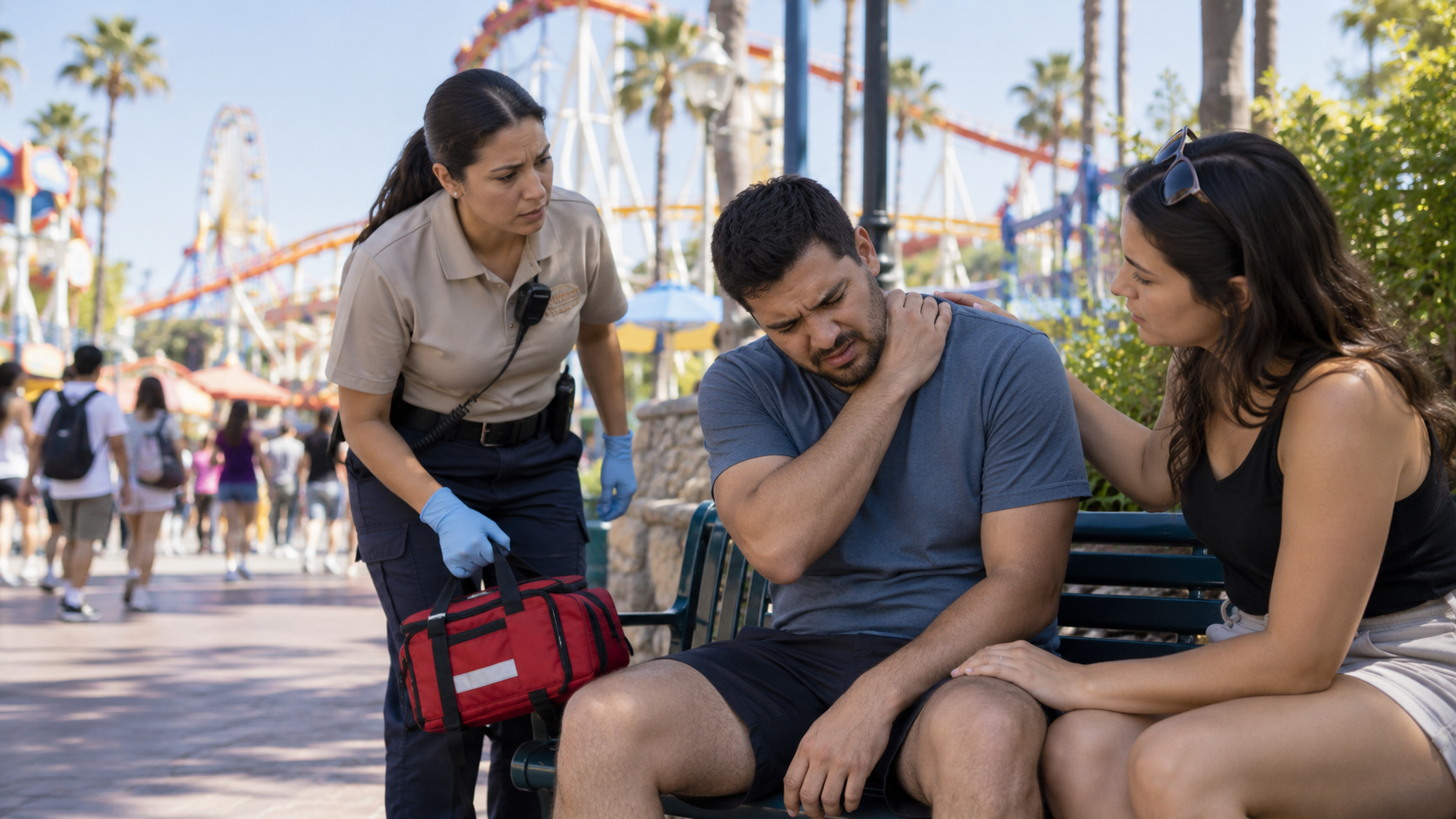
If you or a family member is injured at Six Flags Magic Mountain or any other park in the Santa Clarita area, a few steps make a real difference in preserving your claim:
1. Report the incident immediately and get a copy of the incident report number, not just a verbal assurance one was filed.
2. Seek medical attention, even if the injury seems minor at first. Some injuries, especially soft tissue and head injuries from sudden stops or jolts, don’t show their full severity for days.
3. Take photos of the ride, the area, your injuries, and anything relevant before conditions change.
4. Get names and contact information for witnesses. Park staff will document their own side, but rarely offer to preserve statements that support your version of events.
5. Be careful what you sign or say to a park representative or insurance adjuster before you’ve spoken with an attorney. A recorded statement given in the moment can follow your case for months.
We Meet Our Clients By Accident
Amusement park injury cases move fast, and the parks’ insurers know the process better than almost anyone walking through those gates. My years defending insurance companies before I started representing injured people gave me a front-row seat to exactly how these cases are built against the claimant, and I use that insight every day to build them back in my clients’ favor.
If you or someone you love was hurt at Six Flags Magic Mountain, another amusement or water park, or anywhere in Santa Clarita, Valencia, Canyon Country, Saugus, Newhall, or Stevenson Ranch, I’d be glad to talk through what happened and what your options are.
At The Mason Law Firm, we are committed to helping you recover the compensation you deserve while guiding you through every step of the process.
We offer free consultations and work on a contingency fee basis, meaning you pay nothing unless we win your case.
📞 Call 661-506-2994 for a free consultation.
“We Meet Our Clients by Accident!”
and
“We Put Personal in Personal Injury Law.”
Car accidents, bicycle accidents, bus accidents, motorcycle accidents, pedestrian accidents, truck accidents, slip and falls, dog bites, nursing home abuse cases, burn injuries, construction site accidents, amusement park accidents, brain injuries, spinal cord injuries, wrongful death cases, ride share accidents
Santa Clarita Valley Chamber, Greater San Fernando Valley Chamber, Santa Clarita Bar Association, San Fernando Valley Bar Association, Better Business Bureau, State Bar of California, Justia, avvo, Lexinter Law, linkedin, findlaw, Instagram, Tiktok, Facebook, Youtube, experience.com, TEAM referral network, Cornell Law School, USAttorneys.
Home page, testimonials, blogs, videos, awards, Mason Rashtian, Vision Statement, Facts and questions, contact page.