Authored by Mason Rashtian, Esq. | Personal Injury Attorney, The Mason Law Firm
Dedicated Personal Injury Lawyer in Santa Clarita, Valencia, Canyon Country, Newhall, Saugus, Stevenson Ranch, Castaic, Val Verde, Antelope Valley, Palmdale, Lancaster, the San Fernando Valley, and the Greater Los Angeles Area
Construction sites are among the most dangerous workplaces in California. Every year, thousands of workers and bystanders suffer serious, sometimes fatal, injuries on job sites throughout Los Angeles County and the Santa Clarita Valley.
If you or someone you love has been hurt on a construction site, you may be wondering what your options are and who is actually responsible.
As a personal injury attorney who previously spent nearly a decade defending general contractors, subcontractors, and other construction industry defendants as an insurance defense lawyer, I have a uniquely inside perspective on these cases.
I have sat at the defense table. I know the tactics, the arguments, and the strategies that insurance companies and their lawyers use to minimize, or deny, your claim. I now put that knowledge to work exclusively for injured victims and their families.
Call The Mason Law Firm, managed by Santa Clarita Personal Injury Attorney Mason Rashtian, today at 661-506-2992 for a FREE consultation. We serve clients throughout Santa Clarita, Valencia, Newhall, Saugus, Canyon Country, Stevenson Ranch, Castaic, Val Verde and all of Los Angeles County.
Why Are Construction Sites So Dangerous?
A modern construction project is a complex, constantly changing environment involving dozens of trades and hundreds of workers. At any given moment, a job site might include:
– General contractors overseeing the entire project
– Subcontractors handling framing, plumbing, electrical, concrete, drywall, stucco, grading, roofing, and painting
– Equipment operators running forklifts, cranes, and compactors
– Ironworkers, welders, and scaffold erectors
– Delivery drivers and suppliers moving materials on and off site
– Inspection personnel and project managers
With so many moving parts, accidents are not just possible, they are predictable. Scaffolding gets erected incorrectly or are over loading. Fall protection is insufficient. Holes in flooring are left uncovered. Heavy equipment operators lose sight of workers on foot. Materials are stacked improperly and topple. Electrical work is left exposed. The list goes on.
Call The Mason Law Firm, managed by Santa Clarita Personal Injury Attorney Mason Rashtian, today at 661-506-2992 for a FREE consultation. We serve clients throughout Santa Clarita, Valencia, Newhall, Saugus, Canyon Country, Stevenson Ranch, Castaic, Val Verde and all of Los Angeles County.
The Most Common Types of Construction Accidents
During my years handling construction accident cases on the defense side, I encountered virtually every category of injury imaginable. The most common types include:
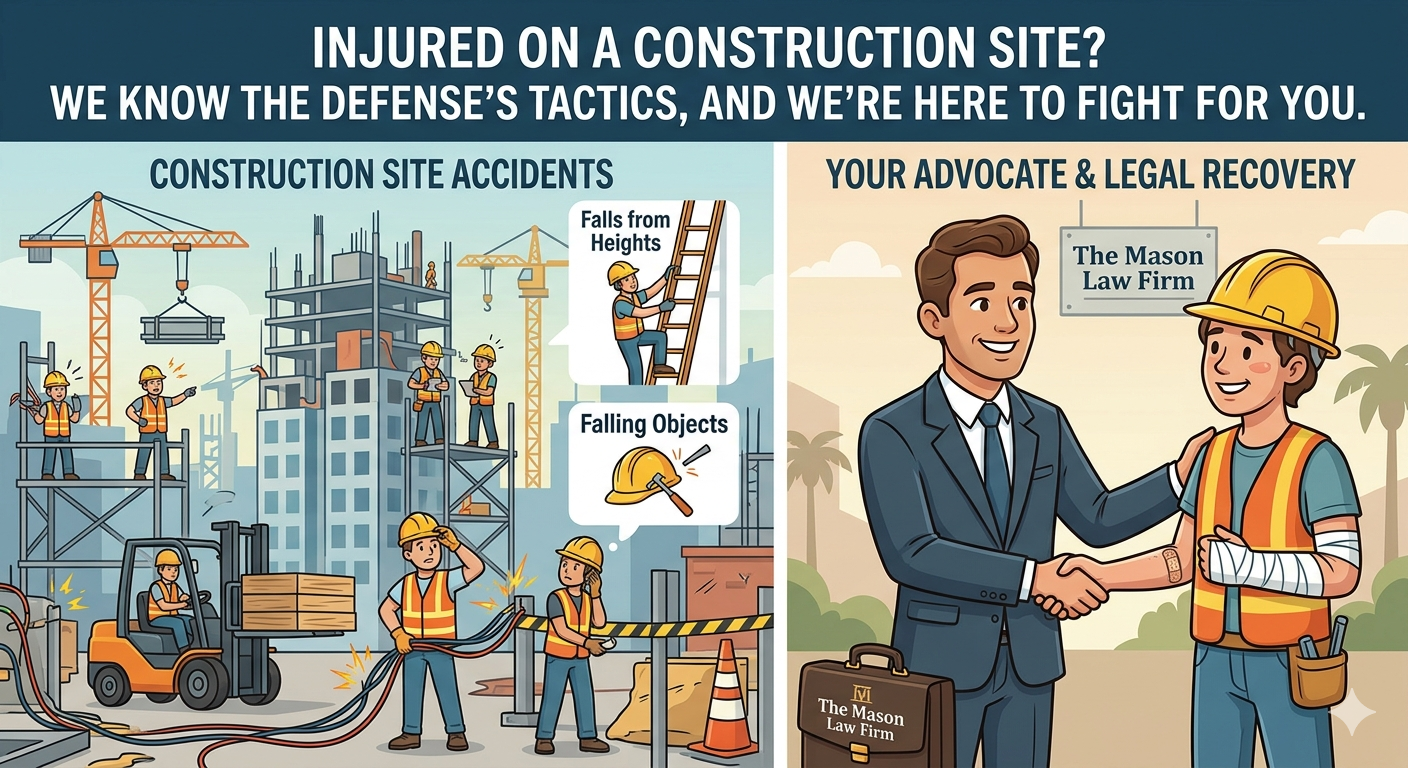
Falls from Heights
Falls from scaffolding, ladders, roofs, and elevated platforms are the single leading cause of construction fatalities.
OSHA’s “Fatal Four” consistently lists falls as the number one killer on job sites. A fall from even a moderate height can result in traumatic brain injury, spinal cord damage, multiple fractures, or death.
Indeed, in my defense days, I handled many injury cases involving failed scaffolding and insufficient fall protection.
Being Struck by Objects
Tools, building materials, and heavy equipment can fall or swing unexpectedly, striking workers below. Cranes, forklifts, and concrete trucks are frequent culprits when proper spotting and safety protocols are ignored.
I recall one case where an employee picked up a nail guard, left behind by another worker, and randomly shot it several time. One of the nails from the nail gun struck and penetrated another worker’s left eye!
Caught-In or Caught-Between Accidents
Workers can be caught in machinery, pinned between equipment and structures, or buried in trench collapses. These accidents are often catastrophic and frequently fatal.
Electrocutions
Contact with exposed wiring, improperly grounded equipment, or overhead power lines causes serious burns, cardiac arrest, and death. Electrical subcontractors and laborers working near wiring are at especially high risk.
Slip and Fall Accidents
Unfinished flooring, wet concrete, debris, and poor lighting create constant slip and fall hazards, including for visitors, inspectors, and delivery personnel on site.
Explosions and Burns
Gas line punctures, flammable material storage violations, and welding accidents can result in severe burn injuries requiring long-term medical care.
Who Is Responsible? Understanding Liability on a Construction Site
One of the most complicated aspects of construction accident cases is determining who is legally responsible. This is an area where my background as an insurance defense attorney gives my clients a real advantage.
During my years defending construction companies, I watched insurance carriers and defense lawyers work hard to shift blame from one party to another, arguing that the general contractor had no control over a subcontractor’s workers, or that a sub-subcontractor was the one truly at fault.
These arguments can be powerful unless you have an attorney who understands how they work and how to counter them.
Potentially liable parties in a construction accident may include:
– The general contractor, who has broad responsibility for overall site safety
– Subcontractors whose workers or negligent practices caused the injury
– Property owners who knew of hazardous conditions
– Equipment manufacturers if a product defect contributed to the accident
– Architects and engineers if a design defect is at issue
– Third-party staffing or labor companies
Identifying all responsible parties is critical, because each one may have its own insurance policy. Failing to pursue all available coverage can leave money on the table that you and your family are legally entitled to.
Workers’ Compensation vs. Third-Party Claims: What’s the Difference?
If you were injured on a construction site as an employee, you are likely entitled to workers’ compensation benefits regardless of fault.
While workers’ comp covers medical treatment and a portion of lost wages, it does not compensate you for pain and suffering, and it often does not tell the whole story of what happened.
In many construction accidents, a third-party civil lawsuit can be pursued separately from, and in addition to, a workers’ comp claim. For example, if you work for a plumbing subcontractor and are injured because a scaffolding company improperly erected a platform, you may have a personal injury claim against the scaffolding company even though your employer’s workers’ comp covers your immediate medical needs.
Third-party claims allow for full compensation, which include pain and suffering, emotional distress, future lost earnings, and loss of enjoyment of life. These are damages that workers’ compensation simply does not provide.
Why My Defense Background Matters for Your Case
Before founding The Mason Law Firm, I spent nearly a decade as an insurance defense attorney, representing general contractors, subcontractors, property owners, and equipment manufacturers in construction accident litigation throughout California. I defended these companies against the very types of claims that I now handle for injured victims.
That experience taught me:
– How insurance companies evaluate construction accident claims internally, and how they decide what to offer
– Which arguments defense lawyers use most often, and how to anticipate and defeat them
– How to read and interpret contracts between general contractors and subcontractors to assign responsibility
– What evidence matters most in proving liability on a job site
– How depositions of site supervisors, safety officers, and OSHA investigators are best conducted
– When and why cases settle, and when they need to go to trial
Simply put: I know what the other side is going to do because I used to do it. That inside knowledge is invaluable when building your case and negotiating with insurance carriers who are working hard to minimize what they pay you.
What to Do After a Construction Site Accident
The steps you take in the immediate aftermath of a construction accident can have a significant impact on your case. Here is what I recommend:
– Seek medical attention immediately, even if you feel you can walk it off. Some serious injuries, including traumatic brain injuries and internal injuries, do not present obvious symptoms right away.
– Report the accident to your supervisor or the general contractor on site. Make sure an incident report is created.
– Document the scene if you are physically able to do so. Photographs of the hazard, your injuries, the equipment involved, and the surrounding conditions can be critical.
– Collect witness contact information from coworkers, bystanders, or anyone who saw what happened.
– Do not give a recorded statement to any insurance company, yours or anyone else’s, before consulting with an attorney.
– Contact an experienced construction accident attorney as soon as possible. Evidence on job sites disappears quickly. Witnesses move on. Surveillance footage gets overwritten. So, time matters.
Contact The Mason Law Firm for a Free Consultation
If you or a family member has been injured on a construction site in Santa Clarita, the Antelope Valley, Los Angeles County, or anywhere in Southern California, The Mason Law Firm is here to help.
We offer free, no-obligation consultations, and we work on a contingency fee basis, meaning you pay nothing unless we recover compensation for you.
We offer free consultations and work on a contingency fee basis, meaning you pay nothing unless we win your case.
📞 Call 661-506-2992 for a free consultation.
“We Meet Our Clients by Accident!”
and
“We Put Personal in Personal Injury Law.”
Updated September 17, 2026
Car accidents, bicycle accidents, bus accidents, motorcycle accidents, pedestrian accidents, truck accidents, slip and falls, dog bites, nursing home abuse cases, burn injuries, construction site accidents, amusement park accidents, brain injuries, spinal cord injuries, wrongful death cases, ride share accidents
Santa Clarita Valley Chamber, Greater San Fernando Valley Chamber, Santa Clarita Bar Association, San Fernando Valley Bar Association, Better Business Bureau, State Bar of California, Justia, avvo, Lexinter Law, linkedin, findlaw, Instagram, Tiktok, Facebook, Youtube, experience.com, TEAM referral network, Cornell Law School, USAttorneys.
Home page, testimonials, blogs, videos, awards, Mason Rashtian, Vision Statement, Facts and questions, contact page,
The information in this blog post is for general informational purposes only and does not constitute legal advice. Reading this post does not create an attorney-client relationship. If you have been injured, please contact an attorney to discuss the specific facts of your situation.