
Authored by Mason Rashtian | Personal Injury Lawyer, The Mason Law Firm
Dedicated Personal Injury Lawyer in Santa Clarita, Valencia, Canyon Country, Newhall, Saugus, Stevenson Ranch, Castaic, Val Verde, Antelope Valley, Palmdale, Lancaster, the San Fernando Valley, and the Greater Los Angeles Area
Here’s a question I get more often than you’d think: “The other driver was working for Uber when they hit me. So, Uber’s insurance covers it, right?”
Sometimes yes and sometimes no, and the difference can be significant.
Before I represented injured people, I spent years on the defense side, and one thing I learned is that rideshare claims are built around a coverage structure most people have never heard of, and companies like Uber and Lyft are not in a hurry to explain it to you.
It’s not illegal for them to stay quiet. It’s just good business for them and a bad surprise for you.
Call The Mason Law Firm, managed by Santa Clarita Personal Injury Attorney Mason Rashtian, today at 661-506-2992 for a FREE consultation. We serve clients throughout Santa Clarita, Valencia, Newhall, Saugus, Canyon Country, Stevenson Ranch, Castaic, Val Verde and all of Los Angeles County.
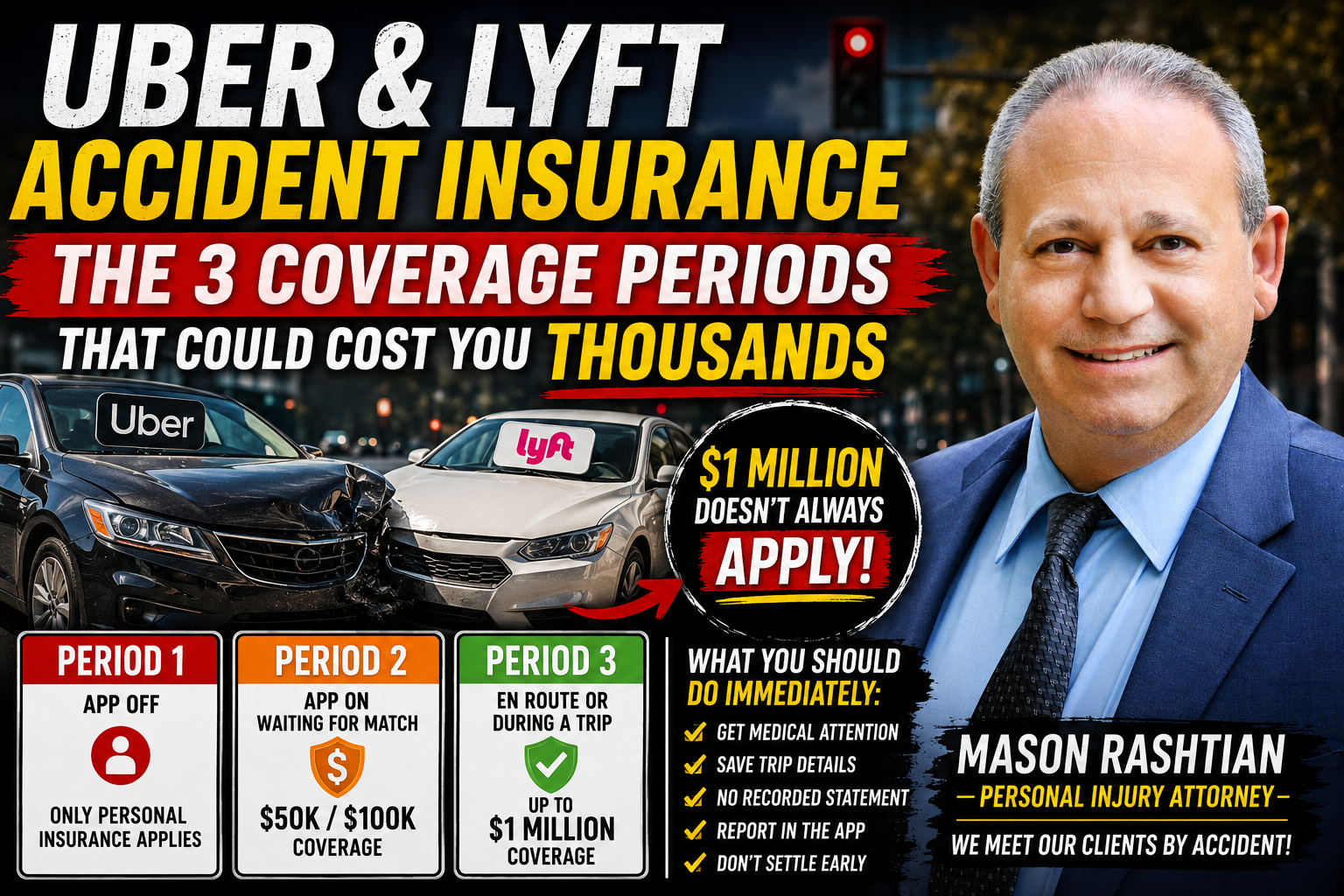
The Three Periods of Rideshare Coverage
California law treats a rideshare accident differently depending on exactly what the driver’s app was doing at the moment of the crash. There are three distinct “periods,” and each one carries a different level of insurance:
1. App Off.
If the driver hasn’t logged into the Uber or Lyft app, they’re just a regular driver in their own car. Only their personal auto insurance applies, and if they were using a personal policy that excludes commercial or rideshare use (many do), you could be looking at a real coverage gap.
2. App On, Waiting for a Ride Request.
Once the driver logs in and is waiting to be matched with a passenger, California law requires Uber and Lyft to provide contingent liability coverage, but at much lower limits than you’d expect: typically $50,000 per person / $100,000 per accident for injuries, and $30,000 for property damage.
If your medical bills are significant, this tier can run out fast.
3. En Route or During a Trip.
Once the driver accepts a ride request, is en route to pick up a passenger, or has a passenger in the car, Uber and Lyft are required to provide up to $1 million in liability coverage. This is the tier most people assume applies to every rideshare accident, and it’s the one the companies are least eager to volunteer information about when it doesn’t.
How This Coverage Structure Came to Be
This isn’t something Uber or Lyft came up with on their own out of generosity. California’s tiered coverage requirements for Transportation Network Companies (TNCs) come out of state legislation and California Public Utilities Commission (CPUC) rules adopted after rideshare companies first exploded onto the scene and lawmakers realized personal auto policies were never designed to cover someone driving strangers around for money.
The tiered system was a compromise: low coverage while a driver waits for a match, and much higher coverage once a driver is actively engaged in a trip.
Knowing that this structure exists because regulators forced it into being, not because Uber or Lyft volunteered it, tells you something important: these companies comply with the letter of the law, but they have no obligation to make the process easy for an injured person to navigate. That part is left entirely up to you, or to whoever you hire to sort it out.
A Scenario I See Often
Picture this: an Uber driver has just dropped off a passenger and is driving home for the night with the app closed. On the way, they run a red light and crash into another vehicle.
Because the app was off at the moment of impact, Uber’s insurance likely doesn’t apply at all and this falls back entirely on the driver’s personal auto policy, which may have limits far lower than what’s needed to cover a serious injury.
Now change one fact: the driver hadn’t logged off yet and was technically still “available” for a match, even though no passenger was in the car. Suddenly the $50,000/$100,000 contingent coverage period applies.
Change the facts one more time: the Uber driver had just accepted a new ride request and was en route to pick someone up. Now, the $1 million policy kicks in.
Same driver. Same car accident. Same intersection. Three completely different insurance outcomes, separated by nothing more than the status of an app most people never think to check. This is exactly why the trip data matters so much, and why it needs to be requested and preserved before it can be lost or disputed.
Why This Matters More Than You’d Think
Here’s what I saw on the defense side, and what still plays out today:
Insurance adjusters, whether they represent the rideshare company’s carrier (i.e. Uber, Lyft or some other rideshare company), or the driver’s own personal insurer, know exactly which period applies before you do.
They also know that injured people often don’t ask the right questions, don’t request the trip data that proves which period was active, and accept an early, low offer because it’s the only number anyone has given them.
If you were a passenger, a pedestrian, a cyclist, or in another vehicle when a rideshare driver hit you, the burden often falls on you to establish which insurance tier applies, using trip logs, driver app status, and timestamps that Uber and Lyft control. Without that data pulled and preserved quickly, you’re negotiating from a position of not knowing what you’re even entitled to.
What to Do After a Rideshare Accident
– Get medical care immediately, even if you feel “okay.” Adrenaline hides injuries, and a treatment gap gives insurers an easy argument that you weren’t really hurt.
– Document the ride. Screenshot the trip details in the app, including the driver’s name, timestamps, and route, before anything changes or expires.
– Don’t give a recorded statement to any insurance company, rideshare or otherwise, before speaking with an attorney. What you say early gets used to minimize what you’re owed later.
– Report the accident through the Uber or Lyft app’s safety reporting feature, which creates a documented record tied to the specific trip.
– Get legal help before accepting any settlement offer. The company or driver’s insurer is not going to volunteer which coverage tier applies or whether a higher one is available.
The Bottom Line
Rideshare accidents look simple on the surface. People think, “Uber driver hit me, Uber must cover it”.
But the coverage structure underneath is anything but simple, and it was built with the rideshare companies’ liability exposure in mind, not your recovery. Knowing which of the three periods applies, and being able to prove it, is often the single biggest factor in what a rideshare injury claim is actually worth.
If you’ve been injured in an accident involving Uber, Lyft, or other rideshare vehicle anywhere in Santa Clarita, Los Angeles, Ventura, or Kern County, we will be glad to review what happened and help you understand what coverage applies and is available to you. It’s worth a conversation before you sign anything or accept an offer. That’s what the free consultation is for.
At The Mason Law Firm, managed by Santa Clarita Personal Injury Lawyer Mason Rashtian, every demand letter is personally reviewed by me, not delegated to a formula or treated like another file on an assembly line.
📞 Call 661-506-2992 for a free consultation.
“We Meet Our Clients by Accident!”
and
“We Put Personal in Personal Injury Law.”
Updated September 15, 2026
Car accidents, bicycle accidents, bus accidents, motorcycle accidents, pedestrian accidents, truck accidents, slip and falls, dog bites, nursing home abuse cases, burn injuries, construction site accidents, amusement park accidents, brain injuries, spinal cord injuries, wrongful death cases, ride share accidents
Santa Clarita Valley Chamber, Greater San Fernando Valley Chamber, Santa Clarita Bar Association, San Fernando Valley Bar Association, Better Business Bureau, State Bar of California, Justia, avvo, Lexinter Law, linkedin, findlaw, Instagram, Tiktok, Facebook, Youtube, experience.com, TEAM referral network, Cornell Law School, USAttorneys.
Home page, testimonials, blogs, videos, awards, Mason Rashtian, Vision Statement, Facts and questions, contact page
The information in this blog post is for general informational purposes only and does not constitute legal advice. Reading this post does not create an attorney-client relationship. If you have been injured, please contact an attorney to discuss the specific facts of your situation.