Authored by Mason Rashtian | Personal Injury Attorney, The Mason Law Firm
Dedicated Personal Injury Lawyer in Santa Clarita, Valencia, Canyon Country, Newhall, Saugus, Stevenson Ranch, Castaic, Val Verde, Antelope Valley, Palmdale, Lancaster, the San Fernando Valley, and the Greater Los Angeles Area
When I worked defense in Los Angeles and Orange County, there was a pattern I saw over and over in pedestrian accidents, and I still see it in nearly every pedestrian case that comes across my desk today in Santa Clarita: the first thing the insurance company does is try to make the accident your fault.
It doesn’t matter if you are in a marked crosswalk, crossing Bouquet Canyon Road and Newhall Ranch Road in Saugus, with the signal in your favor. It doesn’t matter if the driver was looking at his or her phone or was distracted by another billboard!
In fact, it doesn’t have to be on a public road. You could be crossing the parking lot on your way to Trader Joe’s in Canyon Country, or coming out of the local In-n-out on the Old Road in Valencia. The point is, it doesn’t make much difference to the insurance company.
What matter is that regardless of the reason, within days of the crash, an adjuster is already building a file that asks,
- Why you were where you were?
- What were you looking at when you were struck?
- Why didn’t you take evasive action to avoid getting hit by the car?
- Why didn’t you look both direction, twice?
- Why were you wearing clothing that was not reflective or noticeable?
- Were you on your phone talking or texting?
- Why did you step out into the roadway unexpectedly?
I used to help build that file. Now I spend my time taking it apart.
Call The Mason Law Firm, managed by Santa Clarita Personal Injury Attorney Mason Rashtian, today at 661-506-2992 for a FREE consultation. We serve clients throughout Santa Clarita, Valencia, Newhall, Saugus, Canyon Country, Stevenson Ranch, Castaic, Val Verde and all of Los Angeles County.
Why Pedestrian Cases Get Contested So Aggressively
Pedestrian accidents tend to produce serious injuries because there’s nothing between a person’s body and a moving vehicle, and nothing between the person’s body and the ground.
So, it’s not unusual to see such an accident causing:
- Broken bones,
- Broken hips,
- Fractured wrists,
- Fractured ankles,
- Head trauma,
- Brain injuries,
- Back injuries, and
- Spinal damage
Due to the seriousness of such injuries, insurance companies fight harder to reduce what they pay, and in my experience, they don’t fight harder because liability is actually unclear. They fight harder because the exposure is bigger.
An insurance company’s favorite defense tactic is simple: shift as much fault onto the pedestrian as possible. Every percentage point they can pin on you is a percentage point they don’t have to pay.
What California Law Actually Says
Under California law, drivers owe pedestrians a duty of reasonable care, and that duty is heightened in specific situations:
Crosswalks, marked or unmarked.
Drivers must yield to pedestrians who are lawfully crossing, whether the crosswalk has painted lines or is simply the unmarked extension of a corner. A lot of people don’t realize unmarked crosswalks legally exist at nearly every intersection.
Turning vehicles.
A driver making a left or right turn must yield to pedestrians already crossing, even if the driver has a green light.
School zones and residential streets.
Drivers are held to a stricter standard around schools, parks, and neighborhoods where children are more likely to be present.
Backing up in parking lots.
Drivers backing out of a space or driving through a parking lot must watch for pedestrians walking between cars, a common source of injury claims I see from Valencia Town Center and similar shopping areas.
However, none of this means a driver is automatically liable just because a pedestrian was hit. But it does mean the legal presumption often favors the pedestrian, and insurance companies know that. So, their whole strategy is to find facts that flip that presumption, which is exactly why documentation and a fast investigation matter so much.
What If You Were Partly at Fault?
This question comes up constantly, and it stops people from calling an attorney when they shouldn’t let it.
Maybe you were crossing mid-block. Maybe you didn’t see the car coming. Maybe you were speeding. Whatever the reason, you may be partially at fault, but it doesn’t mean that you not entitled to compensation.
California follows pure comparative fault, which means you can still recover compensation even if you share some responsibility for the accident.
For example, if you’re found 20% at fault, you can still recover the other 80% of your damages. The insurance company’s job is to inflate your percentage of fault. My job is to keep it accurate.
Where I See These Accidents Happen Locally
Santa Clarita has grown fast, and a lot of its roads weren’t built with the pedestrian volume they now carry. The patterns I see most often involve:
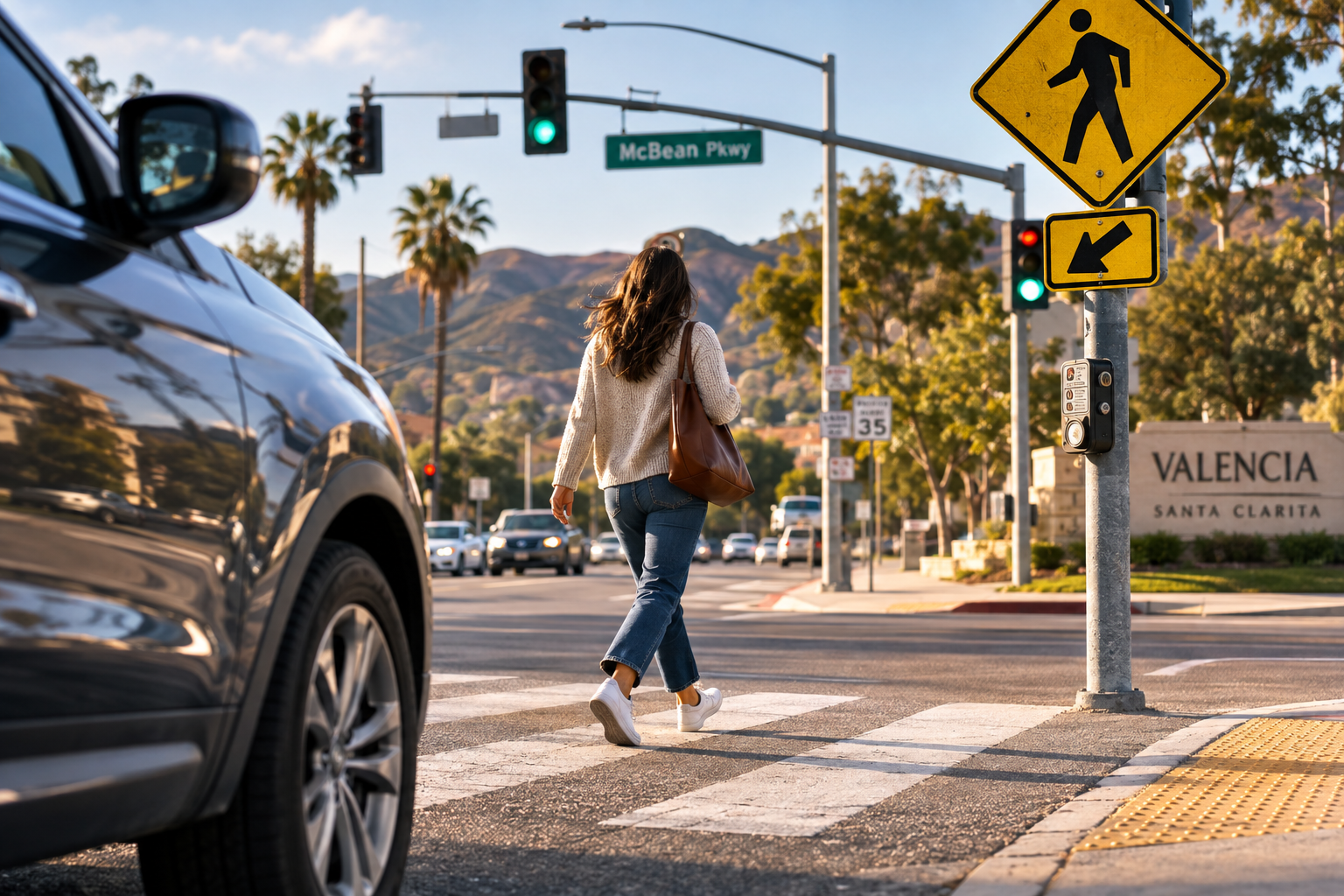
– Busy intersections along McBean Parkway and Valencia Boulevard, where turning traffic and foot traffic collide
– Shopping center parking lots, especially around Valencia Town Center and similar retail corridors
– Poorly lit residential streets in Saugus and Canyon Country, particularly in the evening
– School zones during drop-off and pick-up hours
– Areas near Metrolink stations, where pedestrians are crossing tracks and roadways at the same time
What to Do After a Pedestrian Accident
The steps you take immediately can shape the outcome of your case:
Get medical attention right away.
Even if you feel like you can walk it off. Some of the most serious injuries, including concussions, internal bleeding, soft tissue damage, don’t show symptoms for hours or days.
Call the police and get a report.
An official accident report is one of the strongest pieces of evidence you can have, and it captures details from the scene while they’re still fresh.
Get the driver’s information.
The the driver’s name, license number, insurance, and license plate, and take photos of the vehicle, the intersection, and any relevant signals or signage.
Get witness contact information.
Pedestrian cases often come down to conflicting accounts of who had the right of way. An independent witness can be the difference-maker.
Don’t give a recorded statement to the driver’s insurance company without talking to an attorney first.
An adjuster representing the insurance company will ask questions designed to get you to say something that sounds like an admission of fault. I’ve seen perfectly strong cases weakened by a five-minute phone call taken too early.
Don’t accept an early settlement offer.
Adjusters move fast on pedestrian cases specifically because the injuries tend to be severe, and they want to lock in a number before you know the full extent of your medical needs.
Why My Background Changes the Conversation
I spent years defending these exact claims, arguing that the pedestrian wasn’t paying attention, that the pedestrian darted out in the street, that the pedestrian could not be visible because of the color of his or her clothing.
I know the arguments because I used to write them. Now, when an adjuster tries that playbook on one of my clients, I already know where it’s headed, and I know how to shut it down before it gains traction.
If you or someone you love has been hit as a pedestrian in Santa Clarita or anywhere in the surrounding area, don’t let an insurance company decide how much of the blame belongs to you. Call for a free consultation, and let’s find out what your case is actually worth.
At The Mason Law Firm, managed by Santa Clarita Pedestrian Accident Lawyer Mason Rashtian, every demand letter is personally reviewed by me, not delegated to a formula or treated like another file on an assembly line.
📞 Call 661-506-2992 for a free consultation.
“We Meet Our Clients by Accident!”
and
“We Put Personal in Personal Injury Law.”
Updated September 15, 2026
Car accidents, bicycle accidents, bus accidents, motorcycle accidents, pedestrian accidents, truck accidents, slip and falls, dog bites, nursing home abuse cases, burn injuries, construction site accidents, amusement park accidents, brain injuries, spinal cord injuries, wrongful death cases, ride share accidents
Santa Clarita Valley Chamber, Greater San Fernando Valley Chamber, Santa Clarita Bar Association, San Fernando Valley Bar Association, Better Business Bureau, State Bar of California, Justia, avvo, Lexinter Law, linkedin, findlaw, Instagram, Tiktok, Facebook, Youtube, experience.com, TEAM referral network, Cornell Law School, USAttorneys.
Home page, testimonials, blogs, videos, awards, Mason Rashtian, Vision Statement, Facts and questions, contact page
The information in this blog post is for general informational purposes only and does not constitute legal advice. Reading this post does not create an attorney-client relationship. If you have been injured, please contact an attorney to discuss the specific facts of your situation.