
Authored by Mason Rashtian | Personal Injury Lawyer, The Mason Law Firm
Dedicated Personal Injury Lawyer in Santa Clarita, Valencia, Canyon Country, Newhall, Saugus, Stevenson Ranch, Castaic, Val Verde, Antelope Valley, Palmdale, Lancaster, the San Fernando Valley, and the Greater Los Angeles Area
After an accident or a slip-and-fall, you’re in pain, you’re missing work, and your medical bills are piling up. So naturally, you are stressed, overwhelmed, and perhaps a bit confused.
That’s when insurance companies take advantage, when you are at your most vulnerable! They sound friendly and eager to help, but their intentions are far from that.
Call The Mason Law Firm, managed by Santa Clarita Personal Injury Attorney Mason Rashtian, today at 661-506-2992 for a FREE consultation. We serve clients throughout Santa Clarita, Valencia, Newhall, Saugus, Canyon Country, Stevenson Ranch, Castaic, Val Verde and all of Los Angeles County.
Why Fast Settlements Benefit Insurance Companies
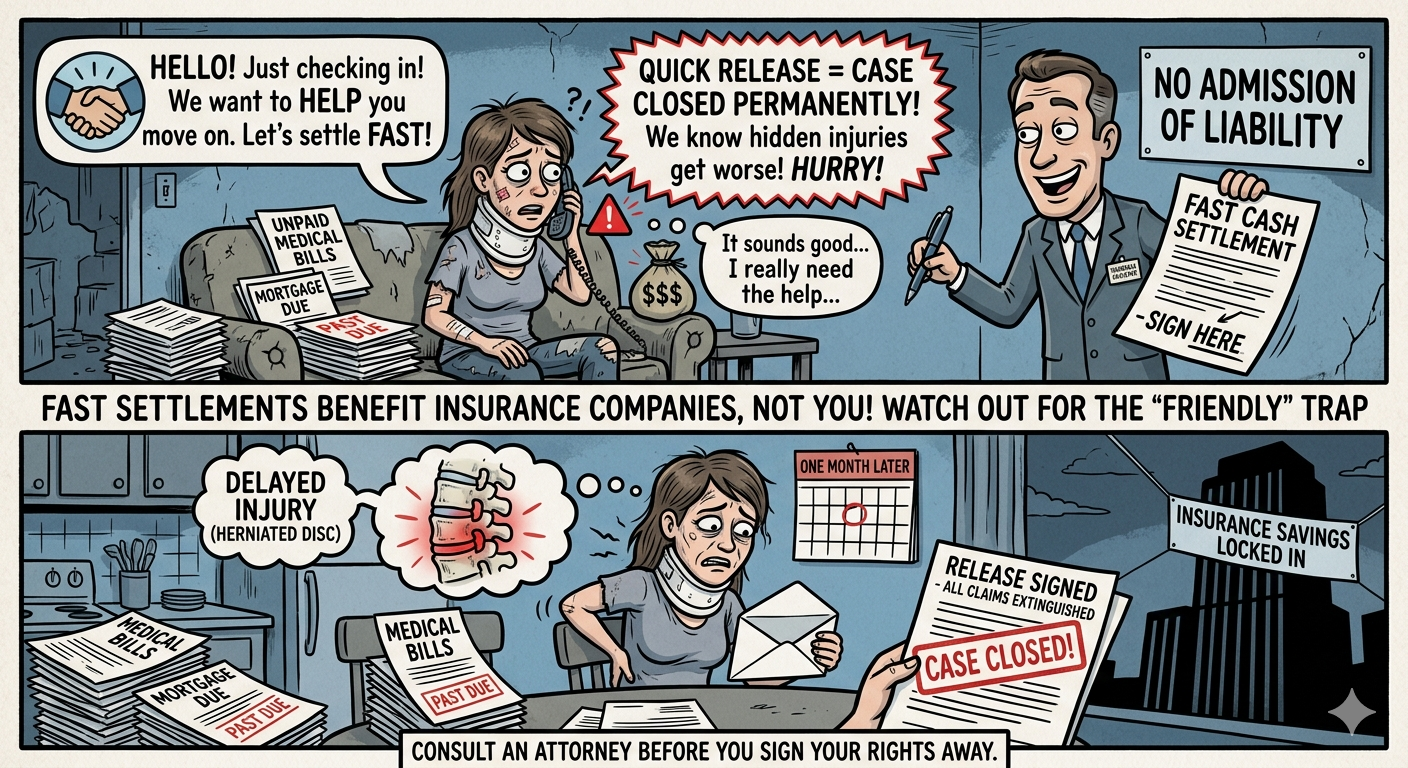
When an insurance adjuster calls shortly after an accident, sometimes within hours, and offers a quick cash settlement, it might feel like a relief.
But that urgency rarely exists for your benefit. Fast settlements are a carefully calculated strategy, and understanding why insurance companies push for them is the first step to protecting yourself.
1. Limiting Exposure
Insurance companies are businesses, and like all businesses, they manage risk. The longer a claim remains open, the more unpredictable it becomes.
An injury that seems minor on day one can reveal complications weeks later. A fender-bender can turn into a chronic pain diagnosis. An accident victim who initially seemed unharmed may discover soft tissue damage that only becomes apparent after inflammation sets in.
By closing a claim quickly, insurers cap their financial exposure at the lowest possible moment, before the true cost of your injuries is known.
Here is the legal ramification: when you accept a settlement, you will need to sign a release. Once you sign that release and accept a settlement, the case is closed permanently, regardless of what symptoms or complications emerge afterward.
So, from a pure risk management standpoint, a fast settlement transforms an open-ended liability into a fixed, controlled cost.
2. Preventing Future Medical Claims
One of the most powerful tools in an insurance company’s settlement arsenal is the full and final release. Buried in that release is language releasing the insurer from all future claims related to the incident, including medical treatment you haven’t received yet.
This matters enormously because many injuries, particularly those involving the spine, brain, or soft tissues, may not fully manifest immediately.
Symptoms of a traumatic brain injury may not be recognized for months, after testing and imaging are performed.
A herniated disc may require surgery a year down the road.
By settling before you’ve completed medical treatment or received a long-term prognosis, you will be signing away your right to compensation for bills that haven’t arrived yet.
The insurance company knows this. So, they settle fast before your medical picture is complete, and before your medical bills pile up.
3. Locking In Low Payouts
The period immediately following an accident is often the worst time to negotiate a settlement, and insurance companies know it.
Victims are frequently in shock, overwhelmed by paperwork, missing work, and facing mounting medical bills. Financial pressure is at its peak, and the temptation to accept any offer for immediate relief is real.
So, insurance companies exploit this window deliberately. Early offers are almost always far below what a claim is actually worth, because they’re made before:
- The full extent of injuries is diagnosed;
- Long-term treatment costs are calculated;
- Lost wages and diminished earning capacity are documented; and
- Pain and suffering damages are fully considered
Once a claimant accepts that early offer and signs the release, the insurer has successfully locked in a payout that may be a fraction of the claim’s true value, and there is no going back to renegotiate.
4. Obtaining Liability Admissions Early or Avoiding Them
Speed also serves insurers in the way facts and statements are gathered. In the chaotic aftermath of an accident, people are often more candid, confused, and unguarded. A quick phone call from a friendly adjuster can yield recorded statements that inadvertently shift blame, understate injuries, or contradict later medical evidence.
Conversely, a fast settlement can be structured to avoid any formal admission of liability on the insurer’s part. The payment is framed as a “nuisance settlement” or goodwill gesture, closing the case without establishing legal fault. This protects the insurer from the claim being used as precedent, prevents potential bad faith findings, and keeps their insured’s record cleaner.
In short, the faster the settlement, the more control the insurance company retains over the narrative, and the less leverage the injured party has to tell their full story.
Injuries Often Get Worse Days or Weeks Later
One of the most dangerous misconceptions after a car accident is the belief that walking away without obvious injury means walking away unharmed.
The human body is remarkably deceptive in the aftermath of trauma because adrenaline masks pain, symptoms develop gradually, and some of the most serious injuries don’t announce themselves until days, weeks, or even months later.
So, understanding the most common hidden injuries can be the difference between protecting your health and your legal rights or unknowingly surrendering both.
1. Whiplash: More Than a Sore Neck
Whiplash is one of the most frequently sustained, and most frequently dismissed, injuries in rear-end collisions. It occurs when the head is violently snapped forward and backward in rapid succession, placing extreme stress on the muscles, ligaments, tendons, and discs of the cervical spine.
The forces involved can cause microscopic tearing in soft tissue that does not appear on standard X-rays, leading insurers and even some physicians to underestimate its severity.
Symptoms of whiplash extend far beyond a stiff neck. Victims commonly experience radiating pain into the shoulders and upper back, chronic headaches originating at the base of the skull, limited range of motion, and persistent muscle spasms.
In more serious cases, the trauma disrupts the discs themselves, causing bulges, herniations, or annular tears that compress nerve roots and produce burning, tingling, or numbness down the arms.
Left untreated or under-treated, whiplash can evolve into a chronic pain condition that affects a person’s ability to work, sleep, and perform basic daily tasks for years.
2. Concussions and Traumatic Brain Injury: When the Damage Is Invisible
The brain is suspended in cerebrospinal fluid inside the skull, and in a collision, even without a direct blow to the head, the brain can strike the interior of the skull with significant force.
The result is a concussion, and in more serious cases, a traumatic brain injury (TBI). What makes these injuries particularly dangerous is how subtle and easily dismissed the early symptoms can be.
In the hours and days following a collision, a concussion may present as mild headaches, dizziness, or general fatigue, symptoms easily attributed to stress or a rough day.
But the true picture is often far more disruptive. Cognitive complaints such as difficulty concentrating, memory lapses, word-finding difficulty, and processing slowdowns are hallmark signs of brain trauma that are frequently overlooked. Mood changes, irritability, sensitivity to light and sound, and disrupted sleep patterns are equally common and equally misunderstood.
Because there is no visible wound, victims are often told they are “fine”, sometimes by emergency room staff relying solely on a CT scan that cannot detect the cellular-level damage a concussion causes. A proper neurological evaluation is essential, and symptoms should never be minimized simply because they are invisible.
3. Herniated Discs: The Injury That Gets Worse Over Time
The spinal discs that cushion the vertebrae are vulnerable to the compressive and shearing forces of a collision.
When the tough outer shell of a disc is damaged, through a tear, bulge, or full herniation, the soft interior can press against nearby nerve roots or, in severe cases, the spinal cord itself. The result is a cascade of symptoms that can range from localized back or neck pain to debilitating nerve pain radiating down the arms or legs.
What makes herniated discs particularly significant from both a medical and legal standpoint is that they are objectively documentable and frequently progressive.
An MRI can reveal disc pathology with precision, annular tears, foraminal stenosis, and cord indentation, providing undeniable evidence of structural injury.
However, many victims are surprised to learn that disc injuries don’t always hurt immediately. The inflammation that causes nerve compression can build gradually over days or weeks, meaning a person may feel relatively fine after an accident only to find themselves barely able to turn their head a month later.
Treatment for herniated discs ranges from chiropractic care and physical therapy to epidural steroid injections, nerve blocks, and in serious cases, surgical intervention, all of which carry real costs that must be accounted for in any fair settlement.
4. Delayed Pain: Why “I Felt Fine at First” Is Not the Whole Story
Perhaps no aspect of accident injuries causes more harm to victims than the phenomenon of delayed pain onset. Indeed, this argument is more frequently exploited by insurance companies than any other.
The body’s response to trauma involves an immediate surge of adrenaline and cortisol that acts as a natural anesthetic, numbing pain signals and masking injury in the critical hours following a collision. This is a survival mechanism, not a sign that nothing is wrong.
Soft tissue injuries, in particular, often reach peak inflammation and pain 24 to 72 hours after the accident, sometimes longer.
Internal injuries, spinal disc damage, and ligament tears may not produce noticeable symptoms until the body’s stress response has fully subsided. This delay creates a dangerous window during which insurance adjusters routinely pressure victims to provide recorded statements, sign medical authorizations, or accept quick settlement offers, all before the true nature and extent of injuries is known.
Accepting a settlement during this window, or failing to seek prompt medical evaluation, can permanently compromise both a victim’s health and their legal claim. The absence of immediate pain is never proof of the absence of injury.
5. PTSD and Anxiety After a Collision: The Wounds You Cannot See
The psychological aftermath of a serious car accident is as real and as disabling as any physical injury. Yet, it is consistently undervalued in personal injury claims and undertreated in general medical practice.
Post-Traumatic Stress Disorder, generalized anxiety, and accident-related phobias are documented, diagnosable conditions that can fundamentally alter a person’s quality of life long after their physical injuries have healed.
Victims may develop an intense fear and anxiety when driving or riding in vehicles, experience intrusive flashbacks or nightmares replaying the collision, or suffer panic attacks triggered by ordinary traffic situations.
Hypervigilance, a persistent state of alertness and dread, can make daily commutes feel overwhelming and isolating. Depression is a frequent companion, as victims grieve the loss of their former sense of safety and independence. Sleep disturbances, emotional numbness, and social withdrawal are also common.
These are not signs of weakness or exaggeration; they are recognized neurological responses to life-threatening events, supported by an extensive body of clinical research.
When calculating the full impact of a collision on a victim’s life, psychological injuries deserve the same serious attention, and the same compensation, as broken bones and herniated discs.
What Are the Common Insurance Adjuster Tactics
Insurance adjusters are not on your side. That is not a cynical opinion, it is simply a reflection of their job description. Their role is to investigate claims and resolve them for as little money as possible on behalf of the insurance company that employs them.
Many adjusters are skilled, professionally trained negotiators who handle hundreds of claims per year. The average accident victim handles one, and walks into the process with no preparation, no experience, and no idea what is being done to them. Understanding the most common adjuster tactics is not paranoia; it is self-protection.
1. Recorded Statements: The Trap Hidden in a Friendly Phone Call
One of the first things an insurance adjuster will do after an accident is request a recorded statement. The ask is almost always framed casually, “We just need to get your account of what happened to move things along.” It sounds routine. It is anything but.
A recorded statement taken in the hours or days immediately following an accident captures you at your most vulnerable, before you fully understand your injuries, before you have spoken with an attorney, and before you have had time to organize the facts.
Adjusters are trained to ask open-ended questions designed to elicit responses that can be used against you later. If you say your pain is “not too bad” on day two, before the inflammation has fully set in, that statement becomes a weapon when you file a claim for a herniated disc six weeks later.
If you speculate about fault or describe the collision in a way that differs even slightly from the police report, that inconsistency will be used to undermine your credibility.
You are under no legal obligation to provide a recorded statement to the opposing party’s insurance company, and in most cases, you should decline until you have spoken with an attorney.
Once medical records are obtained, adjusters are trained to scrutinize them not as medical professionals, but as cost-containment specialists. Their goal is to identify anything that can be used to characterize your injuries as minor, pre-existing, or exaggerated.
Common minimization tactics include dismissing soft tissue injuries as “just whiplash”, despite the fact that soft tissue damage can cause chronic, debilitating pain, and arguing that normal age-related spinal changes, rather than the accident, are the source of your symptoms.
Adjusters may also challenge the frequency or duration of your treatment, suggesting that the number of chiropractic visits or physical therapy sessions was excessive or unnecessary.
Every minimization tactic has the same goal: to justify paying you less than your claim is worth.
Not all pressure looks like pressure. Some of the most effective adjuster tactics are cloaked in warmth, sympathy, and apparent helpfulness.
An adjuster who calls frequently to “check in,” expresses genuine concern for your wellbeing, and positions themselves as your advocate is often executing a deliberate relationship-building strategy designed to lower your guard.
This manufactured rapport serves several purposes. A victim who trusts their adjuster is less likely to hire an attorney, less likely to push back on a low offer, and more likely to share candid information about their injuries, finances, and personal life, all of which can be used to assess how desperate they are and how little it will take to make them settle.
Friendliness is a negotiating tool. The moment you accept a settlement, the warmth evaporates, the file is closed, and the relationship ends. Never mistake professional courtesy for genuine advocacy.
Speed is one of the insurance industry’s most powerful weapons. Shortly after an accident, sometimes within days, an adjuster may present settlement offer, accompanied by release forms that appear straightforward but carry devastating consequences.
A full and final release, once signed, permanently extinguishes your right to pursue any further compensation related to the accident, regardless of what medical developments occur afterward.
If you sign a release and later discover you need spinal surgery, develop chronic nerve pain, or are diagnosed with a traumatic brain injury, you have no legal recourse. None.
The insurance company is protected, and you are left to absorb costs that may be catastrophic. These forms are often presented without explanation, buried in routine-looking paperwork, or accompanied by a check that feels substantial in the moment but is a fraction of what the claim is actually worth.
Never sign a release of any kind without having it reviewed by a personal injury attorney.
One of the most frustrating and frequently deployed adjuster tactics is the use of a claimant’s medical history against them.
If you have ever been treated for back pain, neck stiffness, or headaches at any point in your life, an insurance company will attempt to attribute your current injuries entirely to those prior conditions, effectively arguing that the accident caused nothing and aggravated nothing.
What adjusters routinely fail to acknowledge, or deliberately obscure, is the legal doctrine of the “eggshell plaintiff,” which holds that a defendant takes their victim as they find them.
If a pre-existing spinal condition was asymptomatic or manageable before the collision and became significantly worse as a result of the accident, the at-fault party is liable for that aggravation. The law does not require you to have been in perfect health to deserve compensation.
However, combating the pre-existing condition defense requires thorough documentation, medical records establishing your baseline before the accident, clear physician testimony connecting your worsened condition to the collision, and an attorney who knows how to present that narrative persuasively.
What Happens After You Sign a Release
Of all the moments in a personal injury claim, none carries more permanent consequence than the moment a claimant signs a release. It is a single signature on what often appears to be routine paperwork, and yet it is one of the most legally final acts a person can perform outside of a courtroom.
Insurance companies know this. Most accident victims do not. That asymmetry of knowledge is not accidental; it is the foundation upon which countless low settlements are built.
1. Your Claim Is Permanently and Irrevocably Closed
The moment you sign a full and final release, your claim does not pause, wind down, or enter a waiting period. It ends. Completely. Permanently. Irrevocably.
There is no grace period during which you can change your mind. There is no provision for reopening the file if your condition worsens. There is no mechanism for returning to the negotiating table if new injuries emerge or existing ones prove more serious than initially understood.
A release is a binding legal contract, and courts overwhelmingly enforce them as written. The language buried within these documents, often dense, technical, and presented without explanation, typically releases the at-fault party and their insurer from “any and all claims, known and unknown, past, present, and future” arising from the incident.
That phrase, known and unknown, is doing enormous legal work. It means that even injuries you are entirely unaware of at the time of signing are covered by the release. You are not just settling what you know; you are surrendering the right to compensation for everything you don’t know yet.
Signing without fully understanding that distinction is one of the most consequential mistakes an accident victim can make.
2. No Future Compensation, No Matter What Changes
Life after a car accident rarely unfolds on a predictable timeline. Injuries that appear manageable in the weeks following a collision can deteriorate significantly over months and years.
Nerve damage that produces occasional tingling can evolve into constant, burning radiculopathy. A disc bulge that responds initially to conservative care can migrate, worsen under the stresses of daily life, and ultimately compress the spinal cord.
Cognitive symptoms dismissed as stress can solidify into a documented traumatic brain injury with lasting functional consequences.
None of that matters once a release is signed. The insurance company’s obligation to you ends the moment you accept their check and put pen to paper. It does not matter that your condition has worsened. It does not matter that your treating physician now recommends a more aggressive course of treatment. It does not matter that the compensation you accepted no longer comes close to covering your actual losses.
3. What You Should Do Before You Ever Sign Anything
The answer to every pressure tactic, every friendly phone call, and every settlement offer accompanied by a release form is the same: do not sign anything until you have consulted with a personal injury attorney.
A qualified attorney will review the release language in full, assess whether the offered compensation reflects the true value of your claim, including future medical needs, and advise you on whether your treatment has reached maximum medical improvement, the point at which your medical trajectory is clear enough to negotiate with confidence.
No reputable personal injury attorney will pressure you to accept or reject an offer. What they will do is ensure that if and when you do sign, you understand exactly what you are agreeing to, and that what you are receiving is actually commensurate with what you are giving up. That is not a service the insurance company will ever provide for you.
Why Having a Former Insurance Defense Attorney in Your Corner Changes Everything
Most personal injury attorneys understand the claims process from “one side of the table”. They spend their careers advocating for injured victims, believing they know how insurance companies operate.
Although that experience may be valuable, their knowledge is “limited” because it only comes from the plaintiff’s side of the table. So, no matter how many cases an attorney handles, they cannot comprehend or see the entire picture.
That knowledge comes from having sat on the other side.
I Have Defended the Very Tactics Being Used Against You
Before dedicating my practice to representing accident victims, I spent years as an insurance defense attorney, working directly for insurance companies and the corporations they protect.
That means I was not reading about adjuster tactics in a legal journal or inferring them from the other side of a negotiation. I was part of the system. I attended the strategy sessions. I reviewed the claims files. I understood how cases were evaluated, what thresholds triggered settlement authority, what medical arguments were most effective at reducing payouts, and precisely how the defense machine operates from the inside.
When an adjuster calls my client asking for a recorded statement, I know exactly why. It is because I used those statements myself as leverage to undermine claims.
When a release is presented with a check and a smile, I know what every line of that document is designed to accomplish because attorneys like me helped draft language like it. That insider knowledge is not theoretical. It is operational, and it is deployed on behalf of my clients every single day.
I Know How Insurance Companies Evaluate Your Case
Insurance companies do not evaluate claims the way accident victims do. Where a victim sees pain, disruption, and loss, an adjuster sees data points, liability exposure, medical specials, soft tissue versus hard injury classifications, jurisdictional settlement ranges, and litigation risk assessments.
Every claim is run through a framework designed to produce the lowest defensible number, and that number is informed by years of institutional knowledge about what plaintiffs typically accept and what juries in a given jurisdiction typically award.
Having worked within that framework, I know how to position a case to command maximum value within it. I know which medical documentation carries the most weight, how to present a treatment history to counter the pre-existing condition defense, what evidence adjusters flag as increasing their litigation exposure, and at what point a case becomes more expensive for an insurance company to fight than to fairly resolve.
I do not have to guess at what the other side is thinking, I know because I was once the person doing the thinking.
I Understand the Language of the Defense
One of the most underappreciated advantages of having insurance defense experience is fluency in the language, strategy, and psychology of the defense.
Insurance defense litigation has its own vocabulary, its own playbook, and its own pressure points, and an attorney who has practiced within it communicates differently with opposing counsel than one who has not.
When I send a demand letter, it is written with the knowledge of what a defense attorney looks for, what a claims supervisor needs to justify increasing a reserve, and what language signals that a plaintiff’s attorney is prepared to litigate rather than capitulate.
When I respond to discovery, I anticipate the defense strategy because I have executed that strategy myself.
When opposing counsel attempts to minimize my client’s injuries or challenge the necessity of their treatment, I do not simply object. Instead, I dismantle the argument from the inside out, because I know exactly how it was constructed.
That is a fundamentally different level of advocacy.
I Chose a Different Side, Deliberately
Ultimately, the most important thing my insurance defense background tells you is not just what I know. It is what I decided to do with that knowledge.
After years of watching how the system treats injured people, of seeing firsthand how claims are minimized, how victims are pressured, and how the process is engineered to protect corporations rather than individuals, I made a deliberate choice to change sides.
I did not leave insurance defense because it was failing me professionally. I left because I had seen enough to know that accident victims deserve an advocate who truly understands the machine they are up against, not just someone who has read about it, but someone who helped run it.
Every strategy I once used to defend insurance companies, I now use to anticipate, counter, and defeat those same strategies on behalf of the people who need that knowledge most.
When you hire a former insurance defense attorney to represent you, you are not just hiring a lawyer. You are hiring someone who knows every move before it is made, and who has spent years learning exactly how to stop it.
The bottom line: Experience on the defense side is not a conflict, it is your greatest advantage.
Understanding the opposition from the inside is the most powerful tool in personal injury litigation, and it is one that very few plaintiff’s attorneys can offer. If you have been injured in an accident, you deserve representation that knows the system not from the outside looking in, but from the inside out.
If you sustain injuries from a car accident or a slip-and-fall locally, you may find helpful information on our area-specific pages:
-
👉 Valencia Car Accident Lawyer: https://www.mrscvlaw.com/valencia-personal-injury-lawyer/
- 👉 Saugus Car Accident Lawyer: https://www.mrscvlaw.com/saugus-personal-injury-lawyer/
-
👉 Canyon Country Car Accident Lawyer: https://www.mrscvlaw.com/canyon-county-personal-injury-attorney/
👉 Newhall Car Accident Lawyer: https://www.mrscvlaw.com/newhall-personal-injury-lawyer/We offer free consultations and work on a contingency fee basis, meaning you pay nothing unless we win your case.
📞 Call 661-506-2994 for a free consultation.
“We Meet Our Clients by Accident!”
and
“We Put Personal in Personal Injury Law.”
Updated September 17, 2026
Car accidents, bicycle accidents, bus accidents, motorcycle accidents, pedestrian accidents, truck accidents, slip and falls, dog bites, nursing home abuse cases, burn injuries, construction site accidents, amusement park accidents, brain injuries, spinal cord injuries, wrongful death cases, ride share accidents
Santa Clarita Valley Chamber, Greater San Fernando Valley Chamber, Santa Clarita Bar Association, San Fernando Valley Bar Association, Better Business Bureau, State Bar of California, Justia, avvo, Lexinter Law, linkedin, findlaw, Instagram, Tiktok, Facebook, Youtube, experience.com, TEAM referral network, Cornell Law School, USAttorneys.
Home page, testimonials, blogs, videos, awards, Mason Rashtian, Vision Statement, Facts and questions, contact page.