Authored by Mason Rashtian | Personal Injury Attorney, The Mason Law Firm
Dedicated Personal Injury Lawyer in Santa Clarita, Valencia, Canyon Country, Newhall, Saugus, Stevenson Ranch, Castaic, Val Verde, Antelope Valley, Palmdale, Lancaster, the San Fernando Valley, and the Greater Los Angeles Area
When I spent nearly a decade defending insurance companies, there was no Instagram. No Facebook check-ins, no TikTok, no Strava. If we wanted to know what an injured person was really doing on the weekends, we had to go find out the hard way.
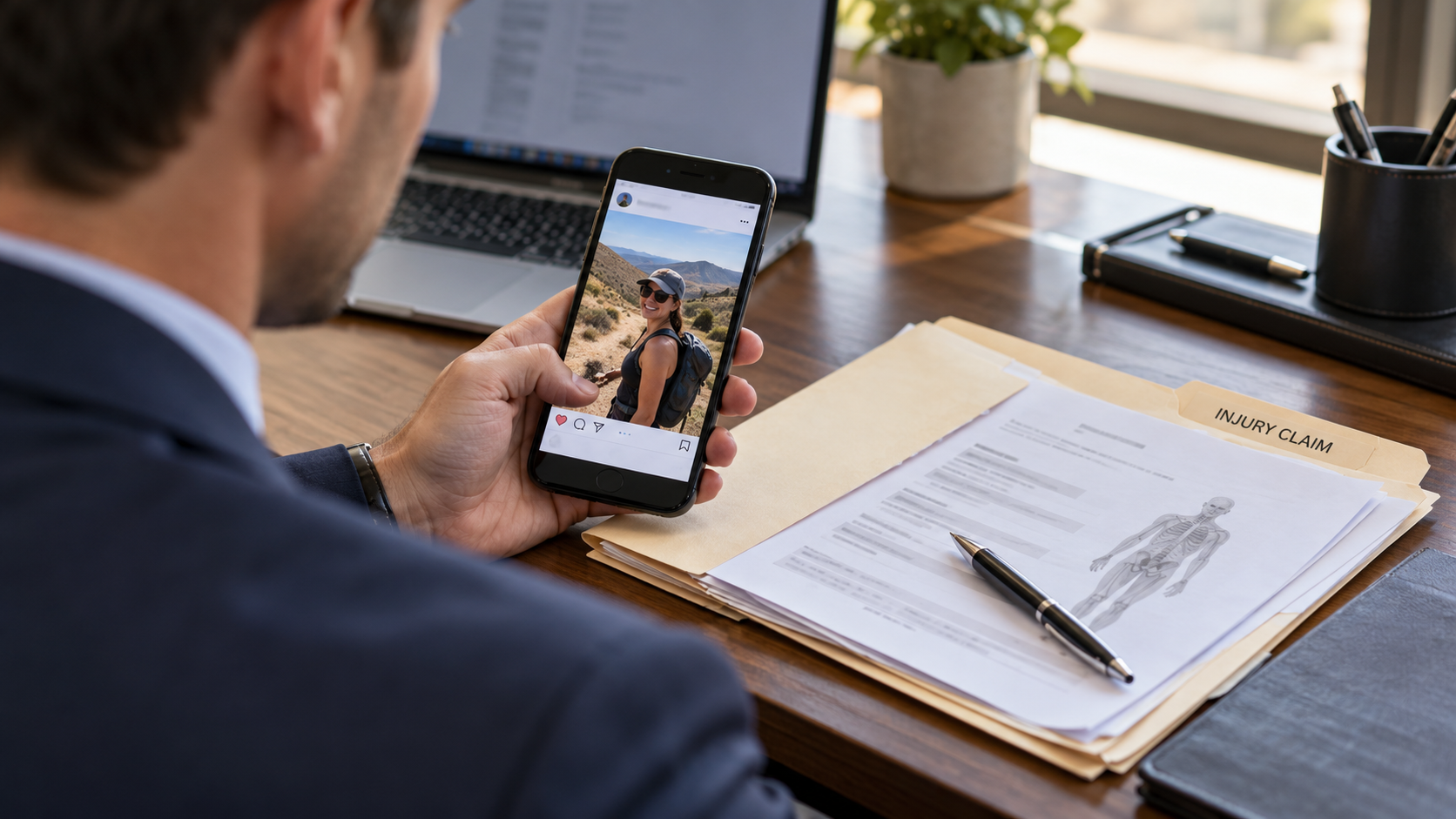
Today, the injured person often hands it to the insurance company for free.
I’ve now seen personal injury cases from both sides of the table, and from both eras. The way insurance companies investigate claims has changed more in the last fifteen years than in the fifty before it. Here’s what changed, what didn’t, and what it means for you if you’ve been hurt in Santa Clarita.
Call The Mason Law Firm, managed by Santa Clarita Personal Injury Attorney Mason Rashtian, today at 661-506-2992 for a FREE consultation. We serve clients throughout Santa Clarita, Valencia, Newhall, Saugus, Canyon Country, Stevenson Ranch, Castaic, Val Verde and all of Los Angeles County.
How the Defense Built Its Case Before Social Media
Before social media, finding evidence that contradicted an injury claim took time, money, and sometimes luck. When I worked in insurance defense, our toolbox included:
Surveillance. A private investigator would park near the claimant’s home with a video camera, hoping to capture activities that appeared inconsistent with the claimed injuries, carrying groceries, mowing the lawn, or loading a truck.
Surveillance was expensive and unpredictable. Investigators often returned with hours of footage showing little more than a closed front door. The insurance company had to spend the money and hope something useful turned up.
In one case, our investigator filmed a plaintiff who reported back pain lifting two child seats. We used that footage to challenge his claimed limitations and credibility. Lifting something does not, by itself, prove someone is uninjured, but it can give the defense material to question their account.
In another case, the investigator parked down the street in a shiny new red truck. Subtle, it was not. I suspected the plaintiff had been warned about surveillance and recognized exactly what was happening.
Records. We subpoenaed medical, employment, and pharmacy records, looking for prior injuries, gaps in treatment, or inconsistencies.
Prior-claims searches. We checked for earlier injury claims. Before social media, there was no scrolling through someone’s profile to see what they had been doing.
Recorded statements and depositions. We pinned down the claimant’s account, including testimony under oath at a deposition, then compared it against the available evidence.
What Social Media Changed
Social media made some of that work much easier. Activities an investigator once spent days trying to capture may now appear online, posted by the claimant, timestamped, and available for anyone to see.
A social media review can reveal:
– Photos and videos of hikes, workouts, sports, travel, moving furniture, or carrying children.
– Check-ins and location tags showing where someone was and when.
– Fitness posts sharing miles walked, run, or biked. Private app data is a separate matter and are sought through discovery after a lawsuit is filed.
– Captions and comments that suggest recovery or describe physical activities. Even a friend’s “Glad you’re feeling better!” may draw scrutiny.
– Posts from other people that tag or feature the claimant, even when the claimant’s own account is private.
What once required thousands of dollars and days of surveillance may now take only a few minutes online. A post does not have to tell the whole story to give the defense something to question.
What Hasn’t Changed: The Goal
The tools have changed, but the strategy is the same one I learned in insurance defense: find something that makes your injuries appear less serious than you claim.
The defense doesn’t have to convince anyone you’re faking to weaken your case. Sometimes, creating doubt about the extent of your injuries is enough. A single photo can become a focal point, drawing attention away from medical records that document your pain and limitations.
That’s what people often miss. You know what happened before and after the photo. The jury, mediator, or adjuster may see only the moment the defense chooses to show them. An innocent post can look very different when someone uses it to argue that you deserve less.
How a Harmless Post Gets Used Against You
A photo captures a single moment. It doesn’t show the pain before, the ice pack after, or the two days you spent on the couch recovering. Here are a few Santa Clarita examples of how ordinary posts can be framed:
– A Halloween photo of you walking the neighborhood in Valencia with your kids becomes “claimant was able to walk for extended periods.”
– A Thanksgiving video of a backyard football game in Saugus, even if you only tossed the ball once, becomes “claimant engaged in athletic activity.”
– A sunset shot from the Towsley Canyon trailhead becomes “claimant went hiking,” even if you never left the parking lot.
– A Six Flags check-in becomes “claimant rode roller coasters,” even if you only sat with the bags while your family rode.
– A smiling photo at Valencia Town Center becomes “claimant showed no signs of pain or distress.”
With the holidays coming, this is the time of year when people post the most. If you have an open injury claim, it’s also the time of year to be the most careful.
Don’t Panic and Delete Everything
Your first instinct may be to clean up your social media accounts. Before you delete anything, talk to your attorney.
Posts, photos, and videos may be relevant to your claim. Removing them can raise questions about whether evidence was improperly deleted and give the defense another reason to challenge your credibility, even if your intent was simply to protect your privacy.
For now, pause new posts, preserve existing content, and ask your attorney about privacy settings and how to handle your accounts while your claim is pending.
Social Media Rules While Your Injury Claim Is Open
1. Stop posting about the accident, your injuries, your treatment, or your case. Not even “feeling better today.”
2. Pause activity posts. No workouts, trips, hikes, or party photos until your case is resolved.
3. Set every account to private. Private isn’t bulletproof, since posts can still be obtained in litigation, but it keeps casual searches out.
4. Ask friends and family not to tag you or post photos of you.
5. Don’t accept new friend or follow requests from people you don’t know.
6. Don’t delete anything without talking to your attorney first.
7. Turn off location sharing and automatic check-ins on your apps.
8. Assume everything is public. If you wouldn’t want an insurance adjuster to see it, don’t post it.
Talk to an Attorney Who Knows Both Sides
I learned how insurance companies build their defense before social media existed, and I’ve watched that same playbook adapt to the age of Instagram. That perspective helps my clients avoid the traps the other side is looking for.
If you’ve been injured in in Santa Clarita, Valencia, Canyon Country, Newhall, Saugus, Stevenson Ranch, Castaic, Val Verde, Antelope Valley, Palmdale, Lancaster, the San Fernando Valley, and the Greater Los Angeles Area, we offer free consultations and work on a contingency fee basis, meaning you pay nothing unless we win your case.
📞 Call 661-506-2994 for a free consultation.
“We Meet Our Clients by Accident!”
and
“We Put Personal in Personal Injury Law.”
Car accidents, bicycle accidents, bus accidents, motorcycle accidents, pedestrian accidents, truck accidents, slip and falls, dog bites, nursing home abuse cases, burn injuries, construction site accidents, amusement park accidents, brain injuries, spinal cord injuries, wrongful death cases, ride share accidents
Santa Clarita Valley Chamber, Greater San Fernando Valley Chamber, Santa Clarita Bar Association, San Fernando Valley Bar Association, Better Business Bureau, State Bar of California, Justia, avvo, Lexinter Law, linkedin, findlaw, Instagram, Tiktok, Facebook, Youtube, experience.com, TEAM referral network, Cornell Law School, USAttorneys.
Home page, testimonials, blogs, videos, awards, Mason Rashtian, Vision Statement, Facts and questions, contact page.