
Author: Mason Rashtian
Dedicated Legal Representation for Injured motorists and passengers in Santa Clarita, Valencia, Canyon Country, Newhall, Stevenson Ranch, Castaic, Val Verde, Palmdale, Lancaster, the San Fernando Valley, and the Greater Los Angeles Area
Every year, millions of Americans are injured in car accidents on roads and highways across the country. According to research gathered by the National Highway Traffic Safety Administration (NHTSA), an estimated 2.44 million people were injured in car accidents in 2023 alone. Indeed, statistics show that injuries from car accidents consistently hover around 2.3 to 2.5 per year.
If you or a loved one has been involved in a vehicle collision in Santa Clarita, the Antelope Valley, the San Fernando Valley, or anywhere in Los Angeles County, understanding the most common types of car accident injuries, and what to do about them, is a critical first step toward protecting both your health and your legal rights, and Santa Clarita Personal Injury Lawyer Mason Rashtian can help.
Why Car Accident Injuries Vary From Case to Case?
No two car accidents are exactly alike, and neither are the injuries that result from them. The nature and severity of injuries sustained in a collision depend on a wide range of factors, including:
1. Direction of impact: Was the injured party struck from behind, from the side, or head-on?
Each direction of force puts different stress on the body.
2. Speed of the collision: Was it a low-speed accident, such as a vehicle stopped at a red light in the San Fernando Valley being rear-ended by a decelerating driver? Or a high-speed crash, such as at a Santa Clarita intersection where a driver ran a red light at full speed?
The velocity of impact dramatically affects the severity of resulting injuries.
3. Body position at the time of impact: Was the injured person facing forward, or were they turned to the side? Was their back fully resting against the seat? Where were their hands on the steering wheel?
Even small differences in positioning can change which parts of the body absorb the most force.
4. Seat belt use: Wearing a seat belt can be lifesaving, but it also means the restraint itself absorbs significant force, which can result in specific injuries to the chest, shoulder, and abdomen.
5. Airbag deployment: While airbags save lives, their rapid deployment can also cause burns, abrasions, and blunt-force injuries, particularly to the face, neck, and arms.
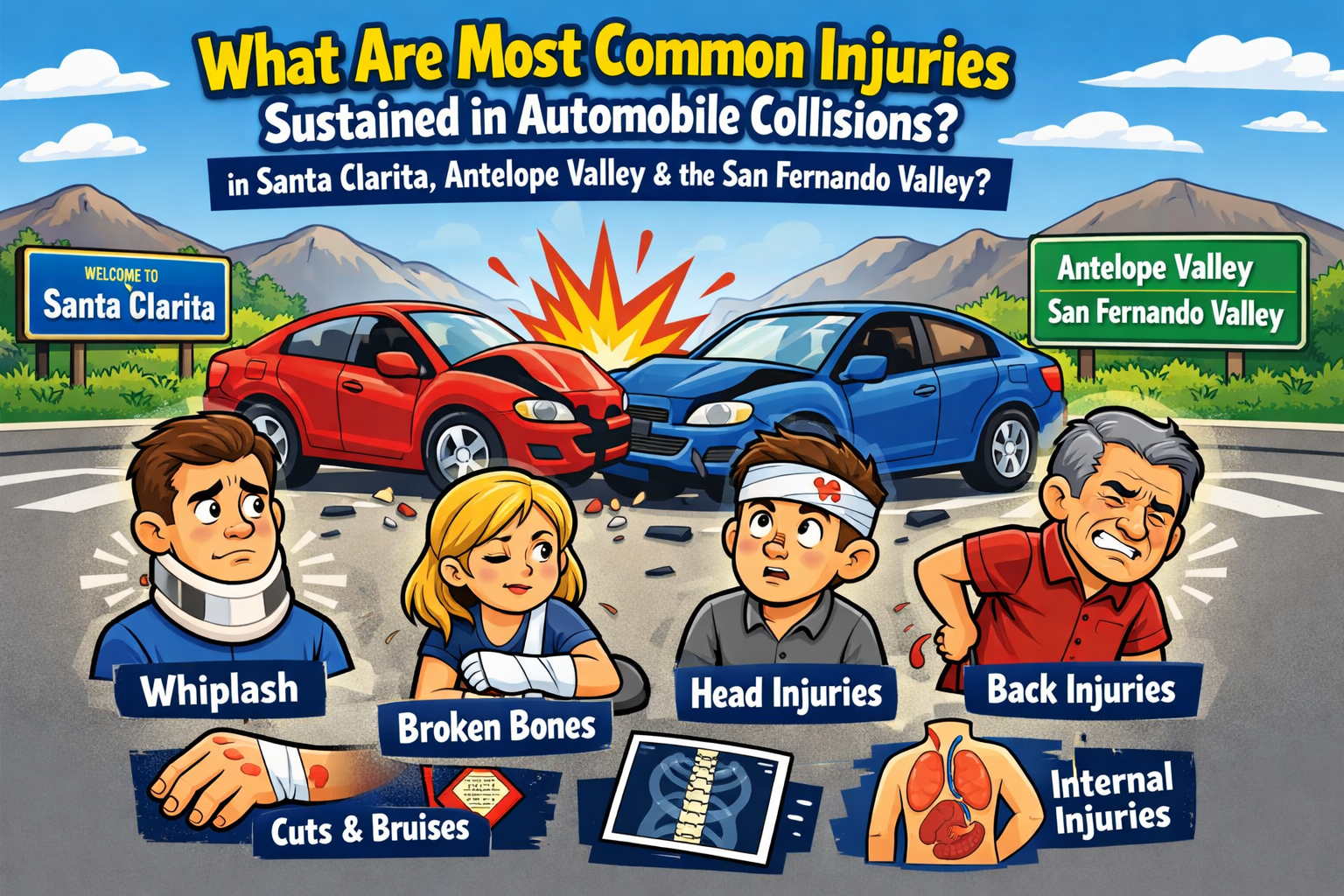
Despite these variables, certain types of injuries appear consistently across car accident cases, regardless of whether the collision happens in Santa Clarita, Valencia, Northridge, or Burbank.
Below is a comprehensive overview of the most frequently seen car accident injuries and their recommended treatments.
What Are Soft Tissue Injuries, Including Whiplash?
Soft tissue injuries are by far the most common injuries resulting from car accidents. A soft tissue injury occurs when muscles, tendons, or ligaments suffer trauma due to the sudden forces generated in a collision.
The most widely recognized soft tissue injury is whiplash. Whiplash occurs when the muscles and ligaments in the neck are stretched beyond their normal range due to the sudden, violent movement caused by impact.
In a rear-end collision, for example, the force from behind abruptly pushes the torso forward while the head momentarily lags, then snaps forward. This rapid back-and-forth motion stretches and strains the soft tissues of the cervical spine, resulting in pain, stiffness, and reduced range of motion in the neck and upper back.
Symptoms of whiplash can include:
- Neck pain and stiffness,
- Headaches originating at the base of the skull,
- Shoulder and upper back discomfort,
- Dizziness,
- Fatigue, and in some cases,
- Tingling or numbness radiating into the arms and hands.
One of the most important things to understand about whiplash is that symptoms often do not appear immediately. It is common for accident victims to feel relatively fine in the hours following a collision, only to wake up the next morning with significant pain and limited mobility.
This delayed onset is one reason why whiplash claims are sometimes disputed by insurance companies, and why prompt medical evaluation is so important.
Beyond whiplash, other common soft tissue injuries seen in car accidents include mid-back and lower back sprains, muscle contusions, and ligament strains throughout the spine.
A rear-end collision can also alter the natural curvature of the cervical spine, straightening what should be a gentle inward curve. This loss of proper spinal alignment places additional and uneven stress on the vertebrae and discs, increasing the risk of chronic pain if left untreated.
Recommended treatment: Soft tissue injuries are generally treated with a combination of chiropractic care (including spinal manipulation, ultrasound therapy, TENS unit therapy, and hot/cold packs) and physical therapy to restore range of motion, reduce inflammation, and rebuild strength in the affected muscles and supporting structures.
Spine and Disc Injuries
In more serious collisions, the impact can injure the spine itself in the neck (cervical) or back (thoracic or lumbar) regions.
Depending on the severity of the force and the position of the body at the time of impact, the vertebral discs, i.e. the soft, cushioning pads between each vertebra can become bulged or herniated (ruptured).
A bulging disc occurs when the disc is pushed out of its normal position without fully rupturing. A herniated disc is more severe, involving a tear in the disc’s outer layer that allows the inner material to press outward and potentially compress nearby nerve roots.
Both conditions can produce significant pain, numbness, weakness, and radiating symptoms down the arms or legs, depending on the location of the affected disc.
These injuries are serious and can have long-term consequences if not properly diagnosed and treated. They are also among the most commonly underdiagnosed injuries following car accidents, particularly when initial imaging focuses only on X-rays rather than MRI studies, which are better suited to detecting soft tissue and disc pathology.
Recommended treatment: Spine and disc injuries require evaluation and care from an orthopedic surgeon or neurosurgeon. Treatment plans typically include pain management, targeted physical therapy, and in some cases, epidural steroid injections or surgical intervention.
Head Injuries and Traumatic Brain Injuries (TBI)
Head injuries sustained in car accidents range from relatively minor bruising and lacerations to serious traumatic brain injuries (TBIs), including concussions and closed head injuries.
Severe head injuries most commonly occur in high-impact accidents such as head-on collisions and T-bone accidents, where the force of impact can cause the head to strike the steering wheel, dashboard, window, or door pillar.
Even without a direct blow to the head, the violent jolting of the skull during a collision can cause the brain to move within the cranial cavity, resulting in bruising or tearing of brain tissue.
Symptoms of a TBI can include:
- Loss of consciousness,
- Confusion,
- Memory problems,
- Persistent headaches,
- Sensitivity to light and sound,
- Mood changes, and
- Difficulty concentrating, a cluster of symptoms sometimes called “post-concussion syndrome.”
Cuts and lacerations to the head and face area may also occur due to flying debris, shattered glass, or contact with airbag materials.
Recommended treatment: Head and brain injuries require immediate evaluation by a surgeon, neurosurgeon, neurologist, psychologist, or neuropsychologist, depending on the nature and severity of the injury. Early diagnosis and treatment are critical for optimal recovery.
Chest Injuries
Chest injuries are less common in minor collisions but can absolutely occur in major accidents, including head-on crashes and T-bone impacts.
The most typical mechanism is the driver’s chest striking the steering wheel or dashboard with significant force. Airbag deployment, while lifesaving, can also deliver a powerful blow to the chest, resulting in injury.
Common chest injuries include bruising of the chest wall, a fractured sternum (breastbone), and broken ribs. These injuries are extremely painful and can make breathing, coughing, or even lying down very uncomfortable.
Recommended treatment: Unfortunately, treatment options for chest injuries are limited. The primary course of action is rest and pain management, as most rib and sternum injuries must heal on their own over time. In severe cases, surgical consultation may be warranted.
Burn Injuries From Airbag Deployment
Airbags contain chemical compounds, specifically sodium azide (NaN3) and potassium nitrate (KNO3), that react rapidly upon activation. When the bumper sensor detects a collision, these chemicals ignite and produce nitrogen gas, inflating the airbag in milliseconds.
While this process is designed to protect occupants, the heat generated by the chemical reaction, as well as the friction of the rapidly deploying fabric, can cause burns to the hands, forearms, neck, and face.
Recommended treatment: Burns from airbag deployment should be treated promptly. Seek first aid from paramedics at the scene, visit an urgent care center, or go to the emergency room depending on the severity of the burns.
Leg and Arm Injuries
Extremity injuries are common in car accidents, particularly in side-impact and frontal collisions. A driver’s knee may be driven forward into the dashboard by the force of impact, causing bruising, deep lacerations, or a fractured kneecap or tibia.
Similarly, a side-impact collision can cause the arms or legs to strike the door panel, center console, steering wheel, or other interior components.
These injuries can range from superficial scrapes and bruises to serious fractures requiring surgical repair.
Recommended treatment: Treatment depends entirely on severity, from ice and rest for minor bruising and contusions, to orthopedic surgery for fractures and ligament tears.
Injured in a Car Accident? The Mason Law Firm Can Help.
If you have been injured in a car accident anywhere in Los Angeles County, including Santa Clarita, Valencia, Canyon Country, Saugus, Stevenson Ranch, Castaic, Val Verde, the San Fernando Valley, or The Antelope Valley, including Lancaster, Palmdale and Acton, you deserve experienced legal representation.
The Mason Law Firm, led by Santa Clarita Personal Injury Attorney Mason Rashtian with over 28 years of litigation experience, is committed to fighting for the compensation you deserve.
We work on a contingency fee basis, meaning there are never any out-of-pocket fees or costs to you.
You may find helpful information on our area-specific pages:
-
👉 Valencia Car Accident Lawyer: https://www.mrscvlaw.com/valencia-personal-injury-lawyer/
-
👉 Newhall Car Accident Lawyer: https://www.mrscvlaw.com/newhall-personal-injury-lawyer/
-
👉 Saugus Car Accident Lawyer: https://www.mrscvlaw.com/saugus-personal-injury-lawyer/
-
👉 Canyon Country Car Accident Lawyer: https://www.mrscvlaw.com/canyon-county-personal-injury-attorney/
We offer free consultations and work on a contingency fee basis, meaning you pay nothing unless we win your case.
📞 Call 661-270-5677 for a free consultation.
“We Meet Our Clients by Accident!”
and
“We Put Personal in Personal Injury Law.”
Car accidents, bicycle accidents, bus accidents, motorcycle accidents, pedestrian accidents, truck accidents, slip and falls, dog bites, nursing home abuse cases, burn injuries, construction site accidents, amusement park accidents, brain injuries, spinal cord injuries, wrongful death cases, ride share accidents
Santa Clarita Valley Chamber, Greater San Fernando Valley Chamber, Santa Clarita Bar Association, San Fernando Valley Bar Association, Better Business Bureau, State Bar of California, Justia, avvo, Lexinter Law, linkedin, findlaw, Instagram, Tiktok, Facebook, Youtube, experience.com, TEAM referral network, Cornell Law School, USAttorneys.
Home page, testimonials, blogs, videos, awards, Mason Rashtian, Vision Statement, Facts and questions, contact page.