
Authored by Mason Rashtian | Personal Injury Lawyer, The Mason Law Firm
Dedicated Personal Injury Lawyer in Santa Clarita, Valencia, Canyon Country, Newhall, Saugus, Stevenson Ranch, Castaic, Val Verde, Antelope Valley, Palmdale, Lancaster, the San Fernando Valley, and the Greater Los Angeles Area
Imagine this scenario: you’re injured in a car accident or slip-and-fall, you see a doctor, and you begin treatment.
Then life happens. Maybe you miss a few appointments. Maybe you start feeling a little better and assume the worst is behind you, so you let the visits slide. It sounds like a reasonable, even responsible choice. So, why keep going to the doctor if you feel okay, right?
Here’s what most accident victims don’t understand until it’s too late: that gap in your medical treatment may be one of the most damaging mistakes you can make for your personal injury case.
As a personal injury attorney, I’ve seen it happen time and time again. A legitimate, injured client loses thousands of dollars, sometimes their entire settlement, because of avoidable gaps in their medical records. This post is here to make sure that doesn’t happen to you.
A gap in your treatment doesn’t just affect your health. It affects your legal rights and your financial recovery.
Call The Mason Law Firm, managed by Santa Clarita Personal Injury Attorney Mason Rashtian, today at 661-506-2992 for a FREE consultation. We serve clients throughout Santa Clarita, Valencia, Newhall, Saugus, Canyon Country, Stevenson Ranch, Castaic, Val Verde and all of Los Angeles County.
What Is a Gap in Treatment?
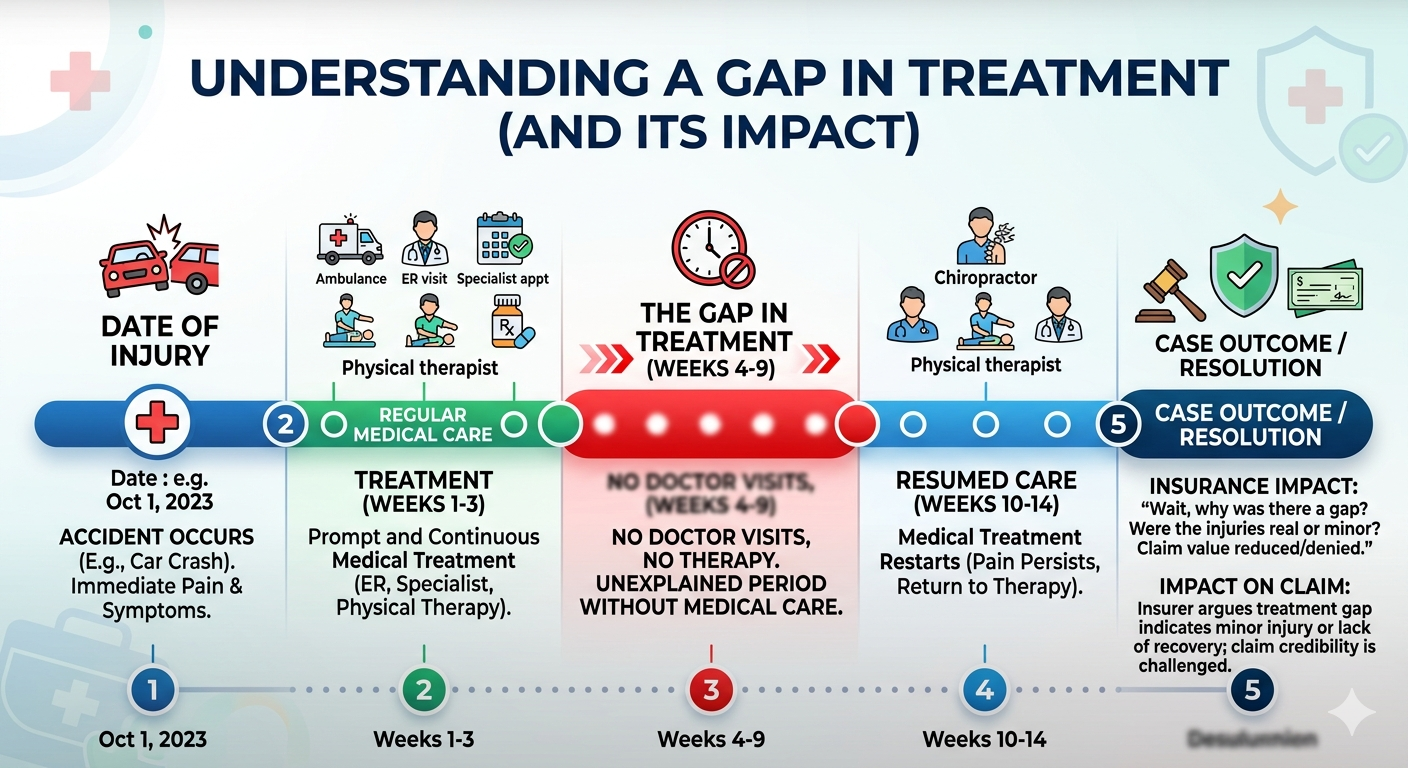
A gap in treatment is any period of time during which you stopped receiving medical care for injuries sustained in an accident. This could be a week, a month, or even longer.
It could happen for entirely understandable reasons:
- You couldn’t get a timely appointment
- You didn’t have health insurance or couldn’t afford the co-pays
- Work or family obligations made it difficult to take time off
- You experienced temporary improvement in your symptoms
- You had anxiety about medical settings or procedures
- You were simply unaware that consistent treatment was so critical
Every single one of these reasons is real, valid, and human. And yet, none of them protect you in the eyes of the insurance industry. That’s the painful reality that every accident victim needs to understand before it’s too late.
How Insurance Companies Use Gaps Against You
Insurance adjusters and defense attorneys are trained to look for weaknesses in your claim. A gap in treatment is one of the most powerful tools they have to reduce or outright deny your settlement.
Here are the three primary ways they will use your treatment gap against you:
1. They Will Argue Your Injuries Weren’t Serious
The logic the defense uses here is simple and devastatingly effective: if you were truly injured and in pain, you would have continued seeking medical care. Full stop.
In their narrative, an injured person doesn’t stop treatment, only someone whose injuries were minor or exaggerated does.
Even if you have medical records showing a diagnosis, a gap gives them the ammunition they need to downplay the severity of your injuries to a jury, a judge, or at the negotiating table.
They will say, “Look, the plaintiff didn’t even feel it was necessary to see a doctor for six weeks. How serious could this really be?”
This argument is particularly damaging in cases involving soft tissue injuries like whiplash, herniated discs, or nerve damage, injuries that may not be immediately visible on imaging but are deeply painful and debilitating in real life.
2. They Will Argue a New Event Caused Your Current Condition
This is one of the most legally sophisticated and damaging tactics in a defense attorney’s playbook.
If you stopped treatment for 30, 60, or 90 days and then returned to a doctor complaining of the same, or worsened symptoms, the defense will argue that “something else” caused your current condition.
Perhaps you were in a minor fender-bender during the gap. Perhaps you lifted something heavy at work. Perhaps you played recreational sports.
Even if nothing out of the ordinary happened, the absence of documented continuous care gives them the narrative hook they need: “The accident didn’t cause the plaintiff’s current condition. Whatever happened during that treatment gap did.”
This argument is especially effective because it’s difficult to disprove without a clean, unbroken medical record. Once the causation chain is broken in the eyes of an insurer or jury, your case becomes significantly harder to win.
3. They Will Attack Your Credibility
In personal injury litigation, credibility is everything.
Juries respond to consistency. When your medical records tell a coherent, continuous story, injury, diagnosis, consistent treatment, documented progress, it’s compelling. It humanizes you and makes your claim believable.
Gaps disrupt that story. They raise questions. Why did you stop going? Did you really need treatment? Were you exaggerating your symptoms to begin with?
Even if the answers to those questions are entirely innocent, the mere fact that the questions can be raised weakens your position.
Defense attorneys know this. They will present your gap to a jury not as an oversight or a logistical challenge, but as evidence of dishonesty or opportunism. Rebuilding credibility after a treatment gap is possible, but it requires strategy, documentation, and expert legal guidance.
The bottom line: every day you go without medical treatment after an accident is another day the insurance company can use to erode your claim.
Why Gaps Happen And Why That Doesn’t Matter to Insurers
I’ve handled hundreds of personal injury cases, and I’ve heard every reason for a treatment gap. Some of the most common ones include:
- No health insurance or unaffordable out-of-pocket costs
- Belief that symptoms were improving and treatment was no longer necessary
- Difficulty navigating the healthcare system to get timely appointments
- Fear or anxiety related to medical settings
- Work schedules that made daytime appointments nearly impossible
- Family caregiving responsibilities that left no time for personal medical needs
I understand all of these. They reflect real constraints that real people face every day. But here’s what I need you to hear: insurance adjusters don’t care why the gap happened. Their job is to minimize what they pay out, and your gap, whatever its cause, is the tool they will use to do that.
Here’s one important piece of information that many accident victims don’t know: if cost is a barrier, you may not have to pay out of pocket at all.
Many personal injury attorneys, including our firm, can connect you with medical providers who work on a lien basis. This means the provider treats you now and gets paid from your settlement later. Cost should never be the reason you stop treating.
What to Do If You Already Have a Gap in Treatment?
If you’re reading this and realizing you’ve already allowed a gap to develop in your treatment, take a breath.
A gap is a problem, but it is not necessarily a case-killer. The key is what you do next. Here is a step-by-step approach drawn from years of experience managing exactly these situations:
Step 1: Restart Treatment Immediately
The most important thing you can do right now is get back to a doctor, chiropractor, or specialist as quickly as possible.
Every additional day you wait makes the gap worse. Even if you feel “okay,” your body may be masking symptoms that will become more serious over time. And from a legal standpoint, restarting treatment is the first step toward rebuilding a credible medical record.
Step 2: Document the Reason for the Gap
When you return to treatment, be honest with your provider about why you stopped.
If there was a specific reason, such as you lost your insurance, you moved, you were caring for a sick family member, make sure it is documented in your medical notes.
Written documentation of a reasonable explanation can go a long way toward neutralizing the defense’s argument.
Write a personal account of the gap in your own words as well. Note the dates, the reasons, any obstacles you faced, and any symptoms you continued to experience even while you weren’t seeing a doctor. This document may become a valuable piece of evidence.
Step 3: Be Consistent Going Forward
Once you restart treatment, do NOT miss appointments.
Follow your treatment plan exactly as prescribed. Consistency going forward cannot erase a past gap, but it can demonstrate to the court and to the insurance company that you are a credible, serious claimant who is committed to your recovery.
Think of it this way: a gap followed by months of diligent, documented treatment is far more defensible than a gap followed by more sporadic care.
Step 4: Contact a Personal Injury Attorney Immediately
This is the most critical step.
An experienced personal injury attorney has seen gaps before and knows how to build a strategy around them. They can work with medical experts to establish the connection between your accident and your current condition, help you document the reasons for the gap, and prepare you to address the issue credibly in negotiations or court.
Don’t try to manage a treatment gap on your own. The insurance company has an entire legal team working to minimize your claim. You deserve the same level of sophisticated advocacy.
A gap in treatment is a challenge, but with the right legal strategy, it doesn’t have to define your case.
The Bigger Picture: Your Health and Your Rights Are Connected
One of the most important things I try to communicate to my clients is this: your medical treatment after an accident is not just about recovering your physical health. It is also the foundation of your legal claim.
Every doctor’s visit, every therapy session, every prescription, every diagnosis, they all of it becomes part of the evidentiary record that supports your right to fair compensation.
When you stop treating, you don’t just risk re-injury or delayed recovery. You actively weaken your legal position. Consistent medical care is simultaneously the right thing to do for your body and the smart thing to do for your case.
Insurance companies spend enormous resources and employ sophisticated algorithms to identify treatment gaps and use them to justify lower offers. They do this because it works. The best way to fight back is to give them no ammunition to work with.
Final Thoughts from Mason Rashtian
If you’ve been injured in an accident, I want you to hear this clearly: your consistent medical care is one of the most powerful tools you have.
Don’t underestimate it. Don’t let logistics, cost, or a false sense of improvement cause you to abandon the treatment plan your doctors have recommended.
And if you’ve already experienced a gap, don’t despair, but do act. Restart treatment. Document everything. And call a personal injury attorney who can help you build a case that accounts for the gap and presents your injuries in their full and truthful context.
You were hurt. You deserve fair compensation. Don’t let a gap in treatment become a gap in your recovery, physically or financially.
If you have questions about your own case or want to understand how a treatment gap might affect your claim, I encourage you to reach out to our office directly. Every case is different, and you deserve personalized guidance from someone who will fight for your rights.
The Mason Law Firm and It’s Founder Mason Rashtian
The Mason Law Firm was founded by Mason Rashtian, a Santa Clarita personal injury attorney, with more than 28 years of litigation experience.
Mason began his legal career in 1997 on the defense side, working for prominent personal injury defense firms in Los Angeles and Orange County. This experience provided him with rare, firsthand insight into how insurance companies think, investigate claims, and build their defenses.
In 2006, he founded The Mason Law Firm in his hometown of Santa Clarita, dedicating his entire practice to representing injured victims throughout the Santa Clarita Valley.
That defense-side background is one of Mason’s greatest strategic assets as a plaintiff’s attorney. He knows precisely how insurance adjusters evaluate injury claims, assign value to damages, and pressure claimants, who are often treated unfairly by the insurance companies, into accepting settlements that fall far short of what their cases are truly worth.
Today, Mason uses that insider perspective exclusively to protect his clients and level the playing field against well-funded insurance carriers.
Throughout his career, Mason has litigated personal injury cases across the entire state of California and applies that deep, statewide experience directly to cases involving injured residents in Newhall and throughout the greater Santa Clarita Valley.
If you sustain catastrophic injuries from a car accident that occurred locally, you may find helpful information on our area-specific pages:
-
👉 Valencia Car Accident Lawyer: https://www.mrscvlaw.com/valencia-personal-injury-lawyer/
- 👉 Saugus Car Accident Lawyer: https://www.mrscvlaw.com/saugus-personal-injury-lawyer/
-
👉 Canyon Country Car Accident Lawyer: https://www.mrscvlaw.com/canyon-county-personal-injury-attorney/
- 👉 Newhall Car Accident Lawyer: https://www.mrscvlaw.com/newhall-personal-injury-lawyer/
Recognized as a Top Personal Injury Lawyers
Mason’s dedication to his clients and his craft has earned him some of the most prestigious recognitions available in the legal profession:
- Super Lawyers: Peer-selected recognition for exceptional legal achievement
- National Association of Distinguished Counsel: Member, Nation’s Top One Percent
- AV® Preeminent Rating from Martindale-Hubbell: The highest possible rating for legal ability and ethical standards, awarded by fellow attorneys and judges
- The National Trial Lawyers Top 100: Recognized as one of the Top 100 Trial Lawyers in the nation
- Ultimate Male Lawyer, voted by the Readers of Elite Magazine
These distinctions reflect Mason’s legal excellence, his ethical standards, and the consistent results he delivers for injured clients throughout Newhall and Los Angeles County.
If you or a loved one has been injured in a car accident, do not wait to seek legal help.
We offer free consultations and work on a contingency fee basis, meaning you pay nothing unless we win your case.
📞 Call 661-270-5677 for a free consultation.
“We Meet Our Clients by Accident!”
and
“We Put Personal in Personal Injury Law.”
Updated September 17, 2026
Car accidents, bicycle accidents, bus accidents, motorcycle accidents, pedestrian accidents, truck accidents, slip and falls, dog bites, nursing home abuse cases, burn injuries, construction site accidents, amusement park accidents, brain injuries, spinal cord injuries, wrongful death cases, ride share accidents
Santa Clarita Valley Chamber, Greater San Fernando Valley Chamber, Santa Clarita Bar Association, San Fernando Valley Bar Association, Better Business Bureau, State Bar of California, Justia, avvo, Lexinter Law, linkedin, findlaw, Instagram, Tiktok, Facebook, Youtube, experience.com, TEAM referral network, Cornell Law School, USAttorneys.
Home page, testimonials, blogs, videos, awards, Mason Rashtian, Vision Statement, Facts and questions, contact page.