
Authored by Mason Rashtian | Personal Injury Lawyer, The Mason Law Firm
Dedicated Personal Injury Lawyer in Santa Clarita, Valencia, Canyon Country, Newhall, Saugus, Stevenson Ranch, Castaic, Val Verde, Antelope Valley, Palmdale, Lancaster, the San Fernando Valley, and the Greater Los Angeles Area
For nearly three decades, I have handled serious injury cases in Santa Clarita, Valencia, and across Los Angeles and Orange County. Before I represented injured people, I spent years on the defense side, defending contractors, property owners, and others against the very claims I now bring.
That background shapes everything about how I handle a burn case, because few injuries are fought as hard by insurers, or misunderstood as often by the people who suffer them.
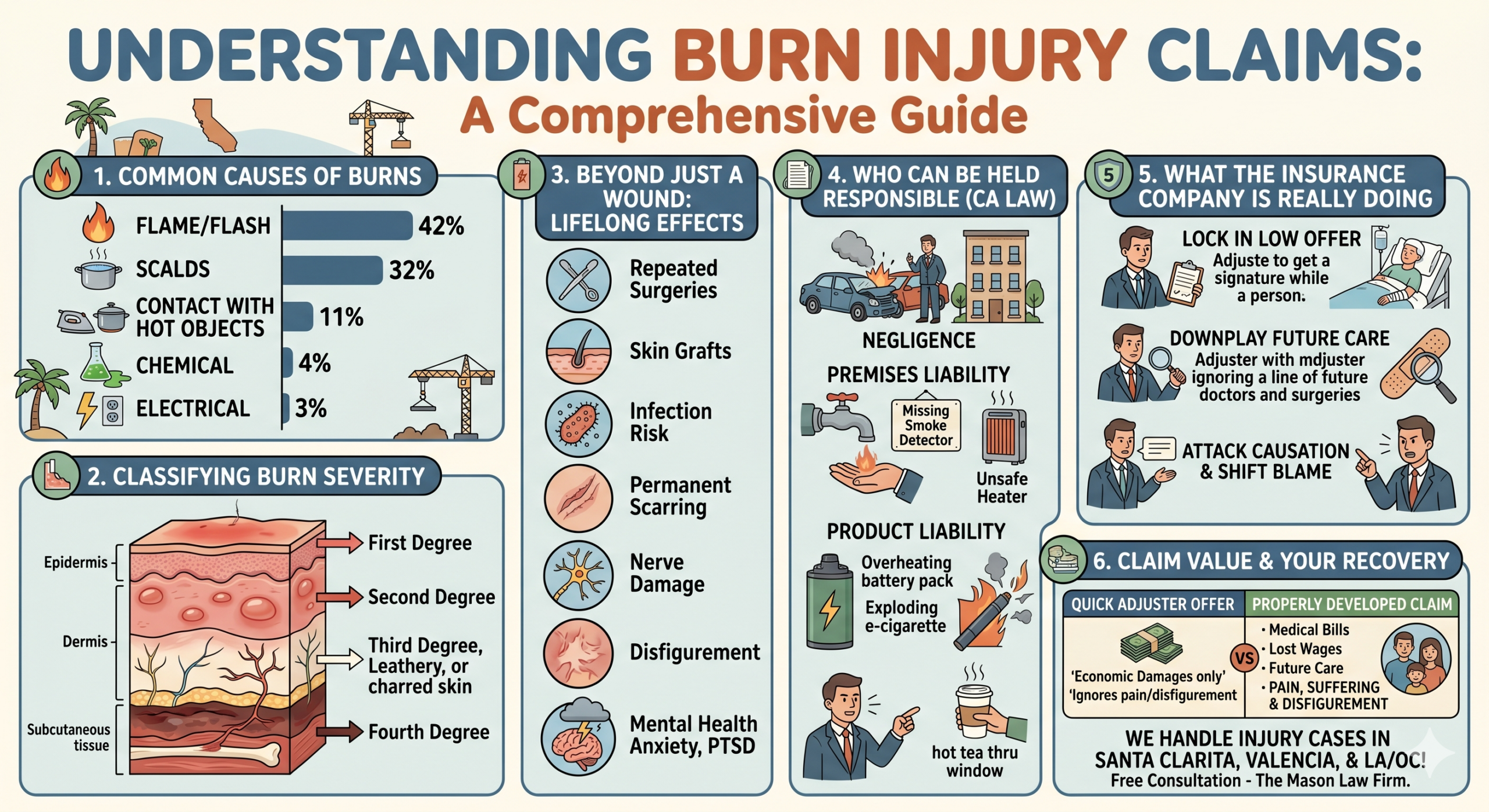
A burn is not just a wound that heals and fades. A serious burn is a lifelong event. It can mean repeated surgeries, skin grafts, infection risk, permanent scarring, disfigurement, nerve damage, and a degree of physical and emotional suffering that most other injuries simply do not produce.
The medical bills for burn injuries are also enormous, the recovery is long, and the consequences follow a person for the rest of their life. Insurance companies know all of this and that knowledge is exactly why they work so hard to pay you as little as possible.
This article explains how burn injuries happen, who can be held responsible under California law, and most importantly, what the insurance company is doing behind the scenes to reduce or deny your claim.
Call The Mason Law Firm, managed by Santa Clarita Personal Injury Attorney Mason Rashtian, today at 661-506-2992 for a FREE consultation. We serve clients throughout Santa Clarita, Valencia, Newhall, Saugus, Canyon Country, Stevenson Ranch, Castaic, Val Verde and all of Los Angeles County.
How serious is the problem?
Burn injuries are far more common than most people realize. The American Burn Association estimates that roughly 600,000 people in the United States suffer a burn serious enough to require emergency care each year.
Survival rates for hospitalized burn patients now exceed 97 percent, which is good news, but survival is not the same as recovery. Many survivors face months of treatment and a lifetime of consequences.
The Association’s data on hospital admissions also tells you something useful about how these injuries occur. The leading cause is:
- Flame or flash burns (roughly 42 percent),
- Scalds from hot liquids and steam (about 32 percent),
- Contact with hot objects (about 11 percent),
- Chemical burns (roughly 4 percent), and
- Electrical burns (around 3 percent).
Burn admissions also spike in the warmer months from May through August. California, with its dense population, year-round construction activity, and recurring wildfire seasons, consistently ranks among the states with the highest number of fire-related injuries and deaths.
Understanding burn severity
Not all burns are alike, and the legal value of a case is closely tied to how deep the damage goes. Doctors generally classify burns by degree:
| Degree | What it affects | Typical signs | Long-term outlook |
|---|---|---|---|
| First degree | Outer layer of skin only (epidermis)
|
Redness, mild pain,
no blistering |
Usually heals on its own within days |
| Second degree |
Epidermis and part of the underlying dermis
|
Blistering, swelling, intense pain | May scar; deeper second-degree burns can require grafting |
| Third degree | Full thickness of the skin |
White, leathery, or charred skin; often numb due to nerve damage
|
Almost always requires surgery and grafting; permanent scarring |
| Fourth degree |
Through the skin into muscle, tendon, or bone
|
Charring, loss of function | Catastrophic; may require amputation; lifelong disability |
There is an important and counterintuitive point hidden in that table. A third-degree burn can be less painful at first than a second-degree burn, because the nerve endings have been destroyed.
So, burn victims sometimes underestimate their injury in the first hours after an accident and insurance adjusters are happy to let them.
How burn injuries happen here in the Santa Clarita Valley
In my practice, burn cases tend to arise from a handful of recurring scenarios:
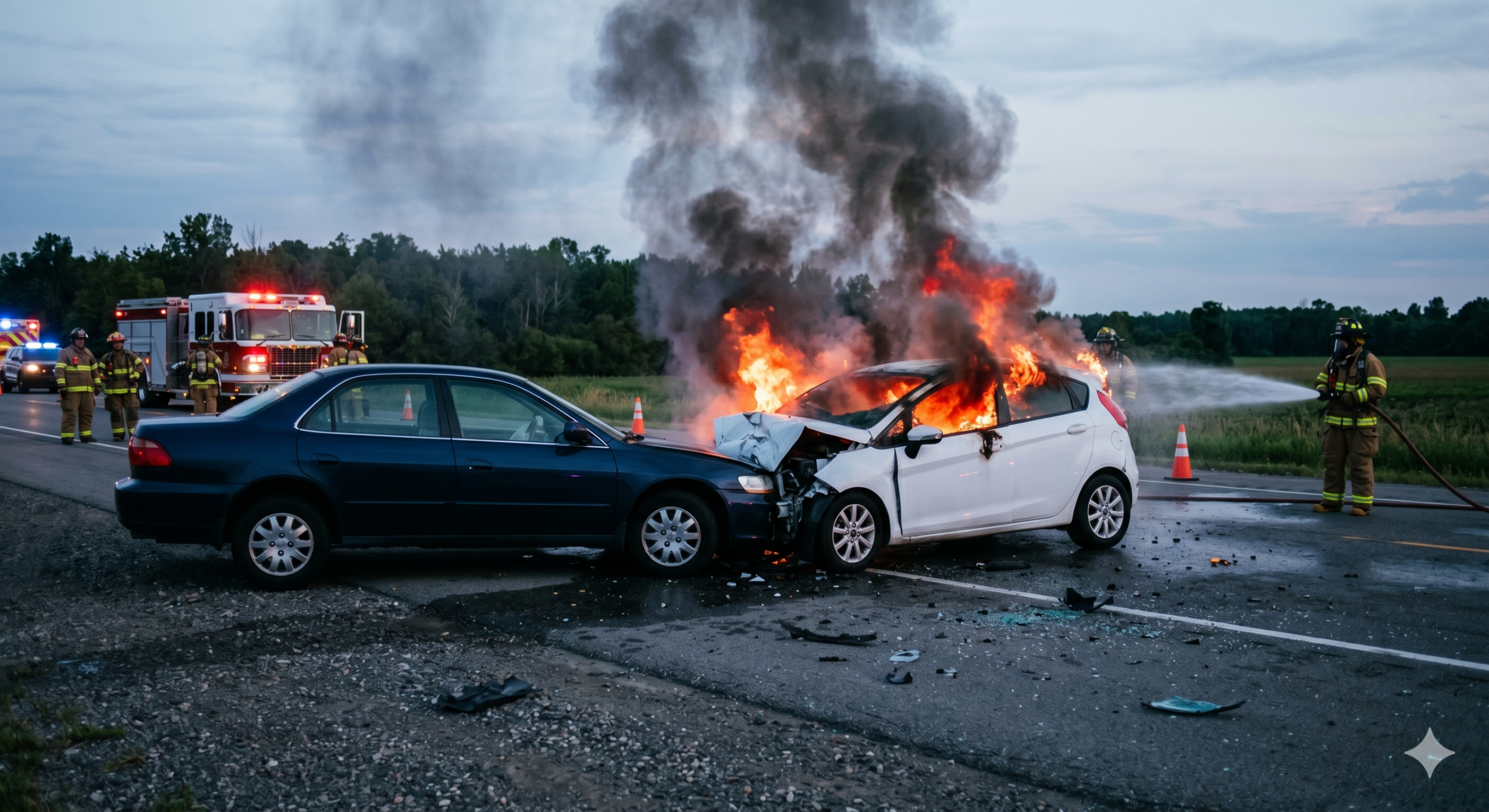
Fires and chemical burns from airbags, fuel, and battery systems can turn a survivable crash into a catastrophic burn injury.
Premises-related burns.
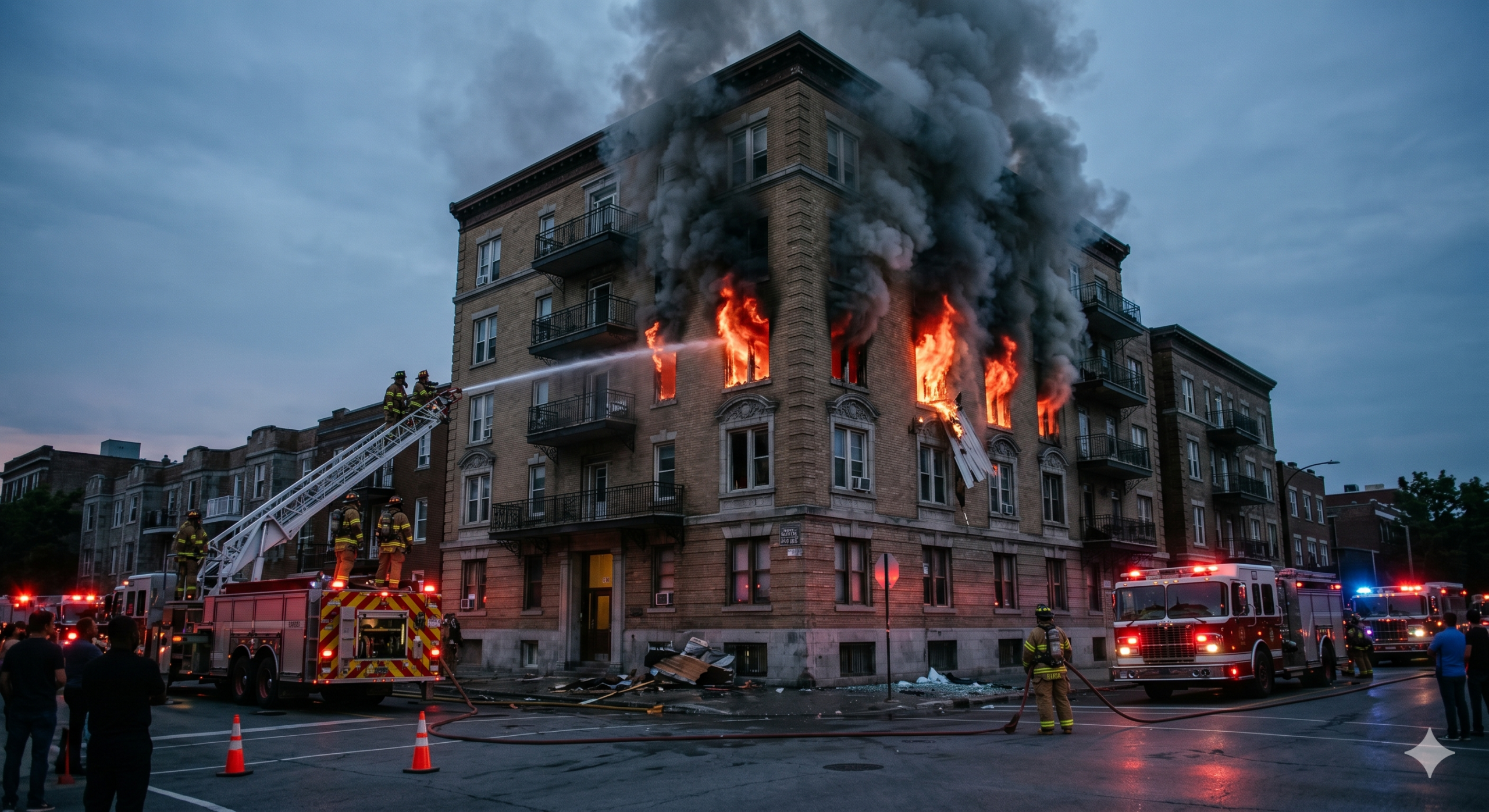 Scalding water in apartments and hotels, restaurant accidents, unsafe heating equipment, and apartment and structure fires caused by landlord neglect, faulty wiring, missing or disabled smoke detectors, code violations, all give rise to premises liability claims.
Example of a case we handled: Our client was a six-year old boy who fell into an open fire pit. He sustained 3rd degree burns on 80% of his body. As if that wasn’t bad enough, his four-year sister witnessed the incident, and kept having recurrent dreams about her brother being on fire.
Construction and workplace accidents.
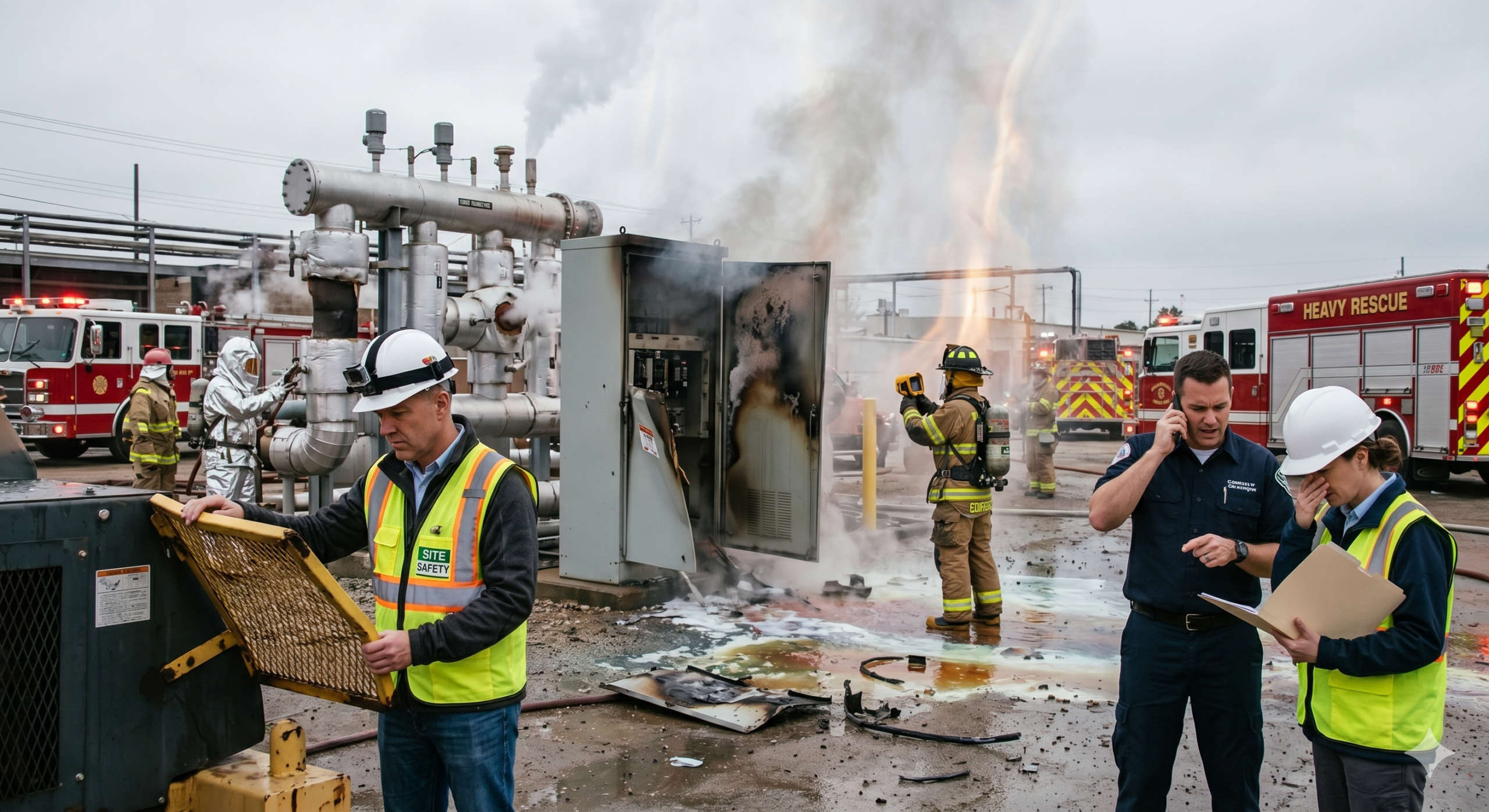
This is the area I know well. On a job site, burns come from electrical contact and arc flash, exposed steam or hot fluids, chemical exposure, flammable materials, and equipment that was poorly maintained or missing safety guards.
Arc-flash incidents in particular can produce devastating burns in a fraction of a second. Because I spent years defending contractors, I know how these companies investigate accidents, what their safety records actually show, and where the documentation tends to fall apart.
Defective and dangerous products.
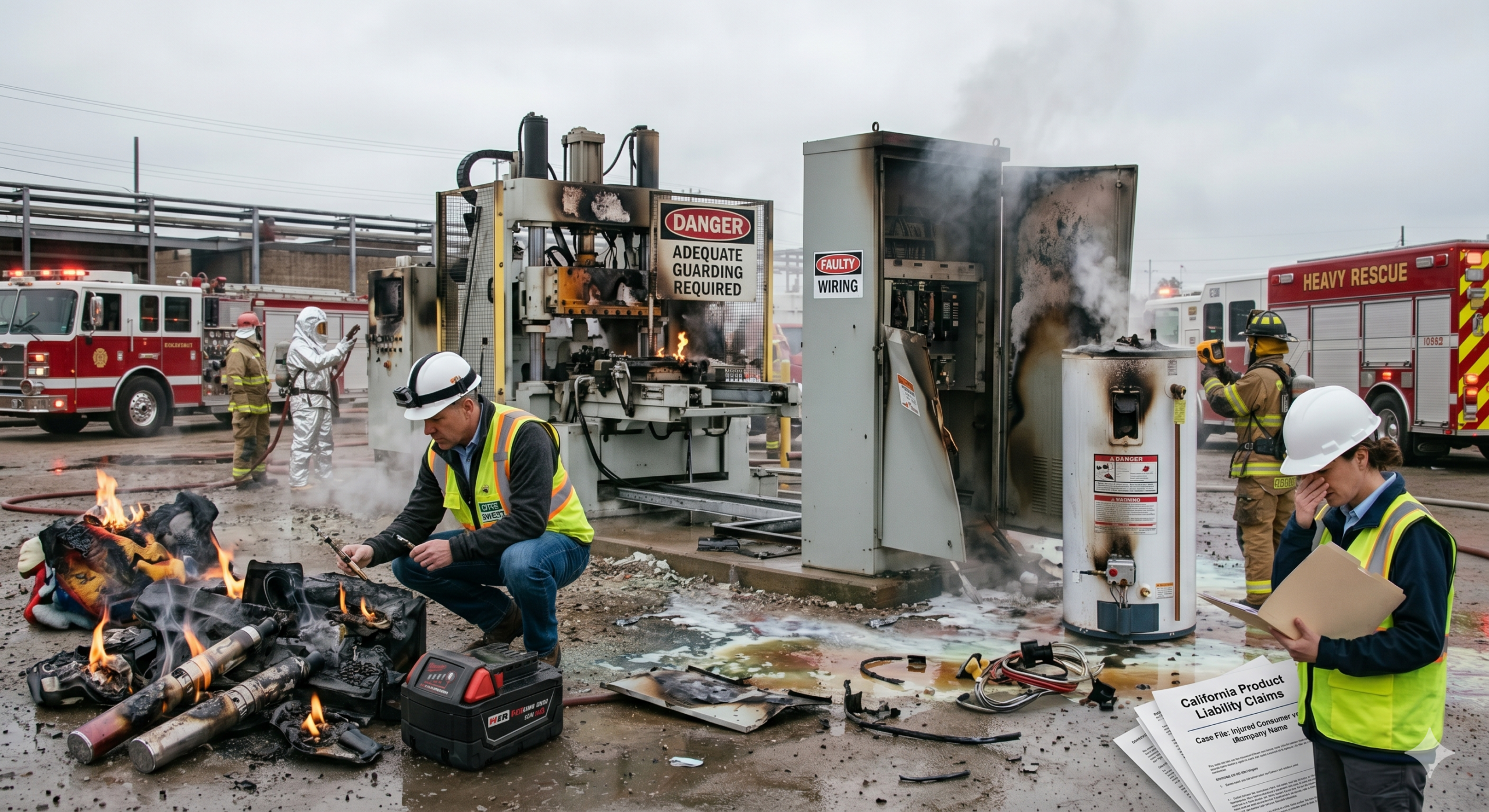
Faulty wiring, overheating lithium-ion batteries, exploding e-cigarettes and vape devices, unsafe water heaters, flammable consumer goods, and industrial equipment with inadequate guarding or warnings all cause burns. These are product liability cases, and California law is favorable to injured consumers here.
Example of a case we handled: We helped a client who suffered second degree burns from hot tea served to her at a Starbucks drive-thru. The incident occurred because the lid of the hot beverage was not properly placed.
Who is responsible under California law?
California gives burn victims several routes to recovery, and the right case often involves more than one.
Negligence.
This is the foundation of most injury claims. If a person in an accident, a landlord or owner affiliated with a certain premises, or a company failed to use reasonable care and that failure caused your burn, they can be held liable for your injuries.
Premises liability.
Property owners and businesses owe a duty to keep their premises reasonably safe and to warn of known hazards. When an unsafe condition, such as bad wiring, scalding tap water, or a missing smoke detector causes a burn, the owner may be responsible.
Product liability.
California applies strict liability to defective products. That means you generally do not have to prove the manufacturer was careless, only that the product was defective and that the defect caused your injury. A defect can be in the product’s design, its manufacture, or in its failure to carry adequate warnings.
Workplace burns and the third-party claim.
This is where my defense experience pays real dividends for clients. If you are hurt on the job, workers’ compensation is usually your exclusive remedy against your employer.
However, it is often not the end of the story. On a construction site especially, you may also have a separate “third-party” liability claim against other negligent parties, including the general contractor, another subcontractor, the property owner, or the manufacturer of a defective piece of equipment.
These third-party claims allow recovery for pain, suffering, and disfigurement that workers’ compensation simply does not pay. Identifying every responsible party is often the difference between a modest comp benefit and full compensation.
What the insurance company is really doing
Here is the part most articles leave out, and the part I understand from having lived it.
When you file a burn claim, a defense team and an adjuster go to work, not to make you whole, but to manage their exposure. Having been on that side, I can tell you what they are doing:
They move fast to lock in a low number.
Adjusters love to reach out early, while you are still in the hospital or still in shock, and offer a quick settlement that sounds like a lot of money.
It is rarely close to what a burn case is worth. Once you sign a release, you cannot reopen it, even when the next surgery, the next infection, or the next graft arrives.
They downplay future care.
Burn injuries are expensive precisely because the treatment continues for years: revision surgeries, scar-management procedures, physical therapy, mental-health treatment.
Adjusters routinely value a claim as if the medical care ended at discharge. It almost never does.
They attack causation.
Expect arguments that your scarring “isn’t that bad,” that a pre-existing condition is to blame, or that the burn would have healed better if you had done something differently.
With chemical and electrical burns, they will dispute exactly how the injury occurred.
They shift blame onto you.
California is a pure comparative negligence state (more on that below), so every percentage of fault they can pin on you directly reduces what they pay.
On a job site, they will argue you ignored a safety procedure. In a product case, they will argue you misused the product. Documenting the scene early, before they do, is critical, which is one reason calling a lawyer quickly matters so much.
They count on you not knowing the full value.
This is the big one. A burn victim who does not understand California damages law will accept a fraction of what their case is worth, and the adjuster knows it.
What your burn claim is actually worth
Under California law, an injured person can recover both economic and non-economic damages.
Economic damages are the measurable financial losses: past and future medical expenses (including future surgeries and lifelong scar treatment), lost wages, and lost future earning capacity if the injury affects your ability to work.
Non-economic damages compensate for pain and suffering, emotional distress, and critically in burn cases disfigurement.
This is where burn cases differ from almost every other injury. Visible, permanent scarring on the face, hands, or body carries substantial non-economic value precisely because it cannot be undone and is carried in public, every day, for the rest of a person’s life.
One California wrinkle worth understanding is Proposition 51. Under it, when multiple parties are responsible, each defendant is liable for non-economic damages only in proportion to its own share of fault (several liability), while remaining jointly liable for economic damages.
So, in a multi-defendant case, such as in a construction accident with a general contractor, a sub, and an equipment maker, apportioning fault correctly across every responsible party is essential to maximizing recovery. That is exactly the kind of analysis I built my career on.
A simplified illustration:
| Quick adjuster offer | Properly developed claim | |
|---|---|---|
| Past medical bills
|
Included | Included |
| Future surgeries &
scar care
|
Ignored | Fully valued with medical experts |
| Lost earning
capacity
|
Overlooked | Calculated for the working life |
| Disfigurement /
pain & suffering
|
Minimized | Valued as a permanent, daily loss |
| All responsible
parties identified
|
Often just one | Every liable party pursued |
The two columns describe the same injury. The difference in outcome is preparation and knowing how the other side thinks.
Two California rules you need to know
The statute of limitations.
In most California personal injury cases, you have two years from the date of injury to file a lawsuit.
There are important exceptions that can shorten or lengthen that window. For example, claims against a public entity (a city, county, or public hospital) generally require a formal claim within six months, and different rules apply to minors.
Miss the deadline and your claim is gone, no matter how strong it was. This is not a deadline to test.
Pure comparative negligence.
California follows a pure comparative fault rule. Even if you are found partly responsible for your own injury, you can still recover, but your award is simply reduced by your percentage of fault.
For example, if you are found 20% at fault, you recover 80% of your damages. This is why insurance companies fight so hard to assign you fault, and why having someone who understands their playbook matters.
Why acting early protects your case
Burn cases are won or lost on evidence, and evidence disappears. The defective product gets discarded. The job site gets cleaned up and the scene changes. Witnesses move on and memories fade. Safety records get “lost.”
Having handled the defense of these claims, I know that the responsible companies begin building their file immediately and so should you.
Getting a Santa Clarita Personal Injury Lawyer involved early means the product is preserved, the scene is documented, the right experts are retained, and the insurance company is dealing with someone who knows exactly what they are trying to do.
“We meet our clients by accident!”
A serious burn changes a person’s life. You should not have to navigate the insurance system, built and staffed by people whose job is to pay you less, while you are also trying to heal.
If you or someone you love has suffered a burn injury in Santa Clarita, Valencia, or anywhere in Los Angeles County, Orange County, Ventura County, or Kern County, The Mason Law Firm offers a free, no-obligation consultation. There is no fee unless we recover for you.
Decades ago I learned how the other side builds its defense. Now I use that knowledge for one purpose, making sure injured people get fairly compensated.
📞 Call 661-506-2992 for a free consultation.
“We Meet Our Clients by Accident!”
and
“We Put Personal in Personal Injury Law.”
Updated September 15, 2026
Car accidents, bicycle accidents, bus accidents, motorcycle accidents, pedestrian accidents, truck accidents, slip and falls, dog bites, nursing home abuse cases, burn injuries, construction site accidents, amusement park accidents, brain injuries, spinal cord injuries, wrongful death cases, ride share accidents
Santa Clarita Valley Chamber, Greater San Fernando Valley Chamber, Santa Clarita Bar Association, San Fernando Valley Bar Association, Better Business Bureau, State Bar of California, Justia, avvo, Lexinter Law, linkedin, findlaw, Instagram, Tiktok, Facebook, Youtube, experience.com, TEAM referral network, Cornell Law School, USAttorneys.
Home page, testimonials, blogs, videos, awards, Mason Rashtian, Vision Statement, Facts and questions, contact page,
The information in this blog post is for general informational purposes only and does not constitute legal advice. Reading this post does not create an attorney-client relationship. If you have been injured, please contact an attorney to discuss the specific facts of your situation.