
Authored by Mason Rashtian
Dedicated Personal Injury Lawyer in Santa Clarita, Valencia, Canyon Country, Newhall, Saugus, Stevenson Ranch, Castaic, Val Verde, Antelope Valley, Palmdale, Lancaster, the San Fernando Valley, and the Greater Los Angeles Area
One of the most damaging myths in personal injury law is also one of the most common.
People injured in a car accident, bicycle accident, truck accident, motorcycle accident, pedestrian accident, a slip-and-fall, a construction site accident, or a burn injury often assume that because they were partly to blame, they have no case. So they never make the call to us or any other personal injury attorney. Instead, they pay the medical bills, absorb the lost wages, and let a legitimate claim quietly disappear.
If that sounds like your situation, it is important for you to know that in California, being partly at fault does not end your claim. In fact, in most cases, it doesn’t even come close.
Call The Mason Law Firm, managed by Santa Clarita Personal Injury Attorney Mason Rashtian, today at 661-506-2992 for a FREE consultation. We serve clients throughout Santa Clarita, Valencia, Newhall, Saugus, Canyon Country, Stevenson Ranch, Castaic, Val Verde and all of Los Angeles County.
How is fault determined in California?
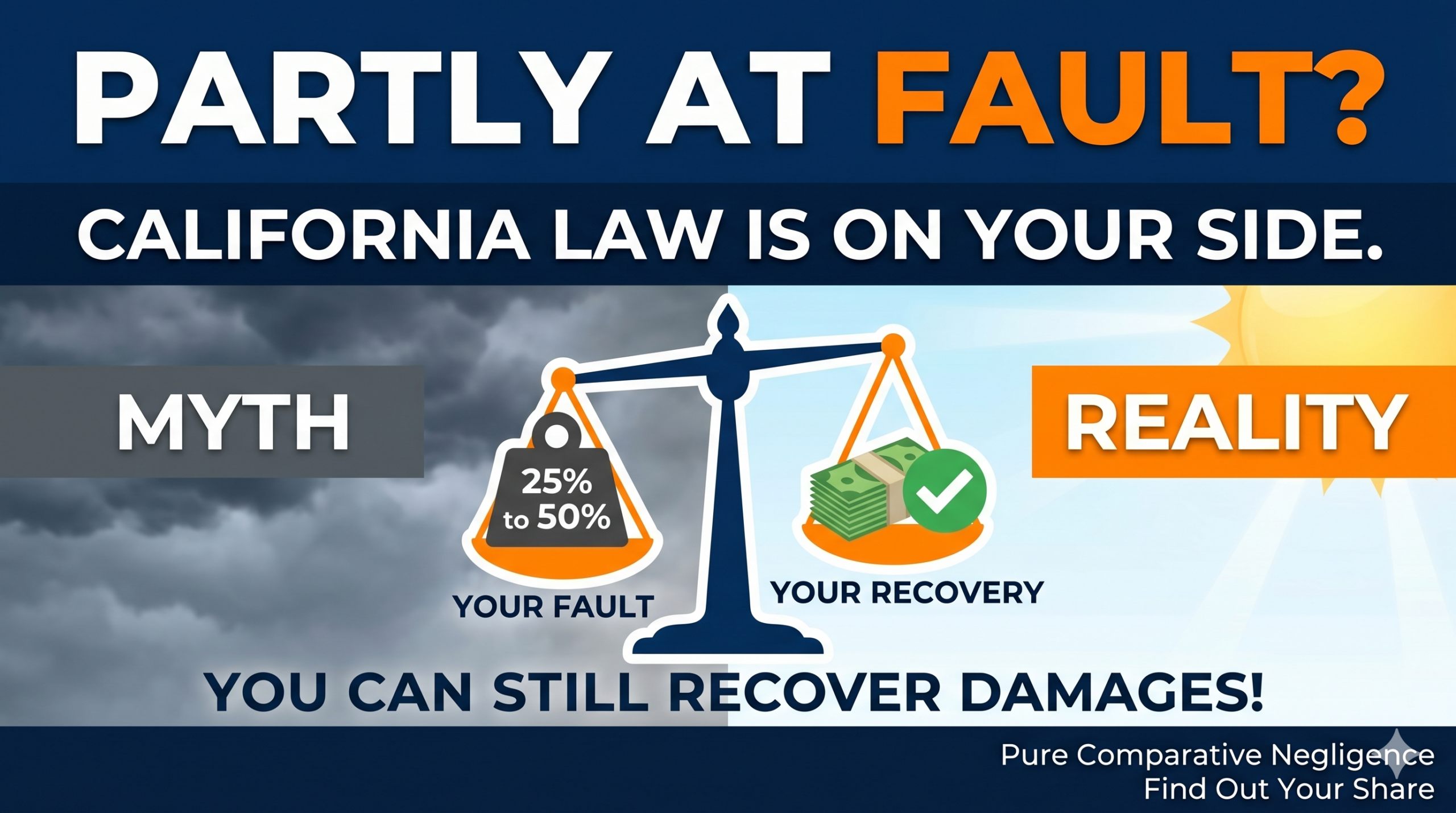
California follows what’s called pure comparative negligence. The rule comes from a 1975 California Supreme Court decision, Li v. Yellow Cab Co., which threw out the old “all-or-nothing” approach that punished injured people for any share of fault.
Under the pure comparative system, a jury (or, more often, an insurance adjuster during negotiations) assigns each party a percentage of fault. All the percentages add up to 100%. Your compensation is then reduced by your own percentage — and nothing more.
That’s it. There is no cutoff that erases your claim. Even a person found 99% at fault can still recover the remaining 1% of their damages. California is one of only about a dozen states this generous to injured plaintiffs.
A simple example
Say you’re rear-ended at an intersection, but it turns out one of your brake lights was out. The insurance company argues that the burned-out light makes you partly responsible.
Suppose your total damages, including medical bills, lost income, pain and suffering, total $100,000, and fault is divided this way:
| Your share of fault | What you can recover |
| 0% | $100,000 |
| 10% | $90,000 |
| 25% | $75,000 |
| 50% | $50,000 |
| 75% | $25,000 |
In a state with a “modified” comparative fault rule, crossing the 50% line would wipe out your recovery entirely. However, in California, it doesn’t.
Instead, your award is simply reduced in proportion to your share of fault. So, you can still walk away with meaningful compensation.
How California compares to other states?
Not every state treats injured people this way, and the differences are stark:
– Pure comparative negligence (California and ~12 others): You can recover even if you’re mostly at fault. Your award is reduced by your percentage.
– Modified comparative negligence (most states): You’re barred from recovering anything once you hit 50% or 51% fault, depending on the state.
– Pure contributory negligence (a handful of states plus Washington, D.C.): This is the harshest rule of all. Even 1% at fault can bar your entire claim.
California sits firmly on the plaintiff-friendly end of that spectrum. If you were injured here, the law is on your side far more than most people realize.
Here’s the catch insurance companies count on
I spent nearly a decade on the other side of these cases, defending insurance companies, general contractors, and property owners against injury claims. So I’ll tell you plainly what I know from the inside: fault percentage is exactly where insurers fight hardest.
Because California reduces your recovery by your share of blame, every percentage point the adjuster can pin on you puts money back in their pocket.
So, on a $100,000 claim, talking you into accepting “just 20% of the blame” saves them $20,000. Accordingly, experienced adjusters are highly motivated to inflate your fault, and they are very good at it.
This is the reason why the friendly adjuster asks for a recorded statement early, before you’ve talked to a lawyer. It’s why some ask leading questions designed to get you to say something that sounds like an admission. It’s why they’re quick to suggest the accident was “really kind of mutual.” None of these tactics are coincidental. Assigning you fault is the strategy.
The mistake injured people make is doing the insurer’s work for them, deciding on their own that they were too much at fault to bother. Don’t disqualify yourself.
The clock is real
California generally gives you two years from the date of injury to file a personal injury lawsuit. This does not apply to medical malpractice cases.
However, if a government or public entity is involved, such as a city, the county, or a state agency, you may have as little as six months to file a formal claim. Waiting too long can end a strong case before fault ever becomes the issue, so the time to get advice is early.
What this means for you
If an adjuster, a friend, or your own worry has you believing your accident was partly your fault and therefore not worth pursuing, take a breath.
Partial fault is normal. Accidents are messy, and California law was built with that reality in mind. The question is almost never “Was I perfect?” It’s “Did someone else’s negligence also cause my injuries?” If the answer is yes, you likely have a claim worth protecting.
The percentage assigned to you is negotiable, contestable, and often inflated by people whose job is to pay you less. You don’t have to accept their number, and you don’t have to face them alone.
Talk to a lawyer who has sat on the other side of the table
At The Mason Law Firm, we’ve recovered more than $75,000,000 for injured clients across Santa Clarita, Valencia, and Los Angeles County.
Before representing injury victims, Attorney Mason Rashtian defended insurance companies in exactly these disputes. So we know how carriers build a fault argument against you, and we know how to take it apart.
If you’ve been injured and you’re worried your share of the blame is a dealbreaker, let us look at it before you decide.
We offer free consultations and work on a contingency fee basis, meaning you pay nothing unless we win your case.
📞 Call 661-506-2992 for a free consultation.
“We Meet Our Clients by Accident!”
and
“We Put Personal in Personal Injury Law.”
Updated September 15, 2026
Car accidents, bicycle accidents, bus accidents, motorcycle accidents, pedestrian accidents, truck accidents, slip and falls, dog bites, nursing home abuse cases, burn injuries, construction site accidents, amusement park accidents, brain injuries, spinal cord injuries, wrongful death cases, ride share accidents
Santa Clarita Valley Chamber, Greater San Fernando Valley Chamber, Santa Clarita Bar Association, San Fernando Valley Bar Association, Better Business Bureau, State Bar of California, Justia, avvo, Lexinter Law, linkedin, findlaw, Instagram, Tiktok, Facebook, Youtube, experience.com, TEAM referral network, Cornell Law School, USAttorneys.
Home page, testimonials, blogs, videos, awards, Mason Rashtian, Vision Statement, Facts and questions, contact page,
The information in this blog post is for general informational purposes only and does not constitute legal advice. Reading this post does not create an attorney-client relationship. If you have been injured, please contact an attorney to discuss the specific facts of your situation.