
Authored by Mason Rashtian | Personal Injury Lawyer, The Mason Law Firm
Dedicated Personal Injury Lawyer in Santa Clarita, Valencia, Canyon Country, Newhall, Saugus, Stevenson Ranch, Castaic, Val Verde, Antelope Valley, Palmdale, Lancaster, the San Fernando Valley, and the Greater Los Angeles Area
One of the most common questions I hear from clients is:
“How did you come up with that settlement demand?”
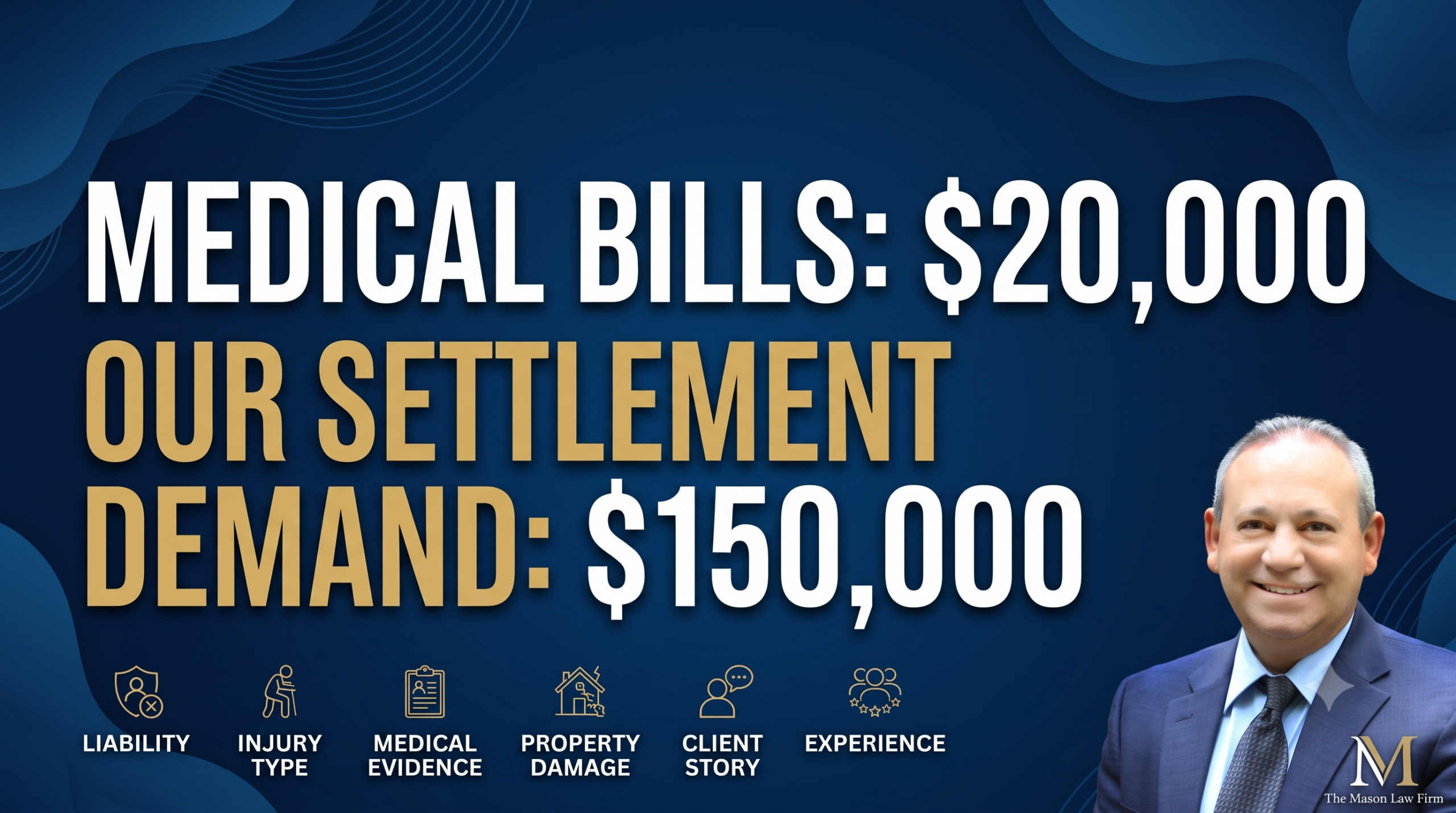
Recently, I represented a client whose medical bills totaled just under $20,000. After carefully reviewing the case, we prepared a settlement demand asking the insurance company for $150,000.
Before we sent the demand, I reviewed it with my client. He looked at me and asked:
“Where did you come up with $150,000?”
It’s a fair question. In fact, I’ve even had attorneys who don’t practice personal injury law ask me the same thing.
The answer often surprises people.
There is no magic formula.
There isn’t a computer program that tells us what your case is worth, and I don’t simply multiply your medical bills by a certain number. Determining the value of a personal injury case requires experience, judgment, and a careful evaluation of many different factors.
Call The Mason Law Firm, managed by Santa Clarita Personal Injury Attorney Mason Rashtian, today at 661-506-2992 for a FREE consultation. We serve clients throughout Santa Clarita, Valencia, Newhall, Saugus, Canyon Country, Stevenson Ranch, Castaic, Val Verde and all of Los Angeles County.
Every Case Starts with Liability
Before I can determine the value of a case, I first need to determine how strong liability is.
That begins by asking:
- Was it a car accident?
- Was it a slip and fall?
- Was it a dog bite?
- Was it a burn injury?
- Was it another type of negligence case?
This is important because each type of case presents different legal issues.
For example, slip and fall cases often involve proving that the property owner knew, or should have known, about a dangerous condition before the accident occurred. That notice requirement is frequently disputed.
On the other hand, dog bite cases in California are generally governed by strict liability, meaning liability is often much easier to establish.
The strength of liability directly impacts the settlement value of a claim.
The Type of Accident Matters
If the case involves a motor vehicle collision, I also evaluate how the accident occurred.
Questions include:
- Was it a rear-end collision?
- Was it a T-bone accident?
- Was it a head-on collision?
- Was it a sideswipe accident?
Different collisions produce different injury mechanisms. This is important because we have to prove a causal connection between the accident and our client’s injuries.
For example, a rear-end collision commonly causes whiplash and other soft tissue injuries, while a high-speed T-bone or head-on collision is generally more likely to produce fractures, traumatic brain injuries, or other objective injuries.
Understanding how the collision occurred helps explain why certain injuries developed.
The Injuries Are Critical
Next, I carefully evaluate the injuries themselves.
Some of the questions I ask include:
- Was the client transported by ambulance?
- Did they go to the emergency room?
- How soon did treatment begin?
- Did they receive physical therapy?
- Were injections necessary?
- Was surgery performed?
- Are there objective findings on MRI, CT scan, or X-rays?
Objective medical findings typically strengthen an injury claim because they provide evidence beyond the client’s complaints of pain.
Medical Bills Tell Only Part of the Story
Many people assume the value of a case is determined simply by adding up medical bills.
That is not how experienced personal injury attorneys evaluate claims.
I certainly review the amount of the medical bills, but I also examine what those bills represent.
For example:
- How much was spent on actual treatment?
- How much was spent on diagnostic testing?
- Has treatment been consistent?
- Has the client reached maximum medical improvement?
Generally speaking, medical bills reflecting meaningful treatment often carry more weight than bills consisting primarily of diagnostic testing.
Property Damage Can Influence Perception
In automobile cases, I also evaluate the property damage.
Now let me be clear: Vehicle damage does not determine whether someone is injured.
I’ve represented clients with significant injuries even though their vehicles sustained relatively minor damage.
However, juries are human.
So, photos of severe vehicle damage often reinforce the seriousness of a collision, while minimal damage frequently becomes an argument insurance companies use to challenge the extent of the injuries.
Although there is no direct relationship between vehicle damage and bodily injury, it can influence how a case is perceived.
Every Client Is Different
The client is just as important as the injuries.
I consider factors such as:
- Age of the client
- Our client’s overall health before the incident
- Whether the injuries are permanent
- Whether there is scarring or disfigurement
- The impact on work, hobbies, and daily life
For example, permanent facial scarring may affect different people in different ways depending on their age, occupation, and circumstances.
I also take time to understand each client’s personal story.
Every client has a different reason for pursuing a claim. Some simply want their medical bills paid, while others are primarily concerned about future medical care, lost income, or the lasting impact the injuries have had on their lives.
Understanding those goals helps shape our settlement strategy.
Credibility Matters
Another factor many people overlook is “credibility”.
If a case ultimately goes to trial, or even to a deposition, I need to evaluate how the client will present to a jury, or a defense attorney who will evaluate the client as a witness at his or her deposition.
Jurors tend to respond well to witnesses who are:
- Honest
- Likeable
- Consistent
- Credible
A strong, likable, believable witness can significantly increase the value of a case. For example, the value of a case for four year girl who was mauled by a dog is generally higher than a case for a 75 year old male.
Insurance Companies Are Not All the Same
People often assume every insurance company evaluates claims the same way.
They don’t.
So, I also consider:
- Which insurance company is handling the claim?
- Which regional claims office has the file?
- Is it a self-insured Defendant?
- Whether the claim is against another driver or under my client’s uninsured/underinsured motorist coverage.
- Current trends within the insurance industry.
These factors often affect how negotiations proceed and how an opening demand should be presented.
Why the Opening Settlement Demand Matters
Once I have evaluated all of these factors, I determine an opening settlement demand that strikes the right balance.
The goal is twofold.
First, it gives my client enough room to negotiate toward a fair settlement.
Second, it is supported by the facts, medical evidence, and applicable law so that the insurance company takes the demand seriously and engages in meaningful settlement discussions.
An opening demand should never be an arbitrary number. It should reflect a thoughtful evaluation of the case while positioning the client for successful negotiations.
Experience Makes the Difference
When someone asks me how I arrived at a $150,000 settlement demand on a case involving approximately $20,000 in medical bills, the answer is simple.
I didn’t multiply the medical bills by a certain number.
I evaluated every factor that could influence the outcome of the case.
That approach comes from experience.
For nearly 30 years, I have litigated personal injury cases from both sides of the courtroom. Before representing injured individuals, I represented insurance companies evaluating and defending these very same claims. Today, I also serve as a Settlement Officer for the Los Angeles County Superior Court, helping parties resolve disputes before trial.
Having evaluated thousands of personal injury claims, I know that every case is unique.
There is no one-size-fits-all formula.
Every client is different.
Every case is different.
And every case deserves its own strategy.
Have Questions About the Value of Your Personal Injury Case?
If you’ve been injured in a car accident, slip and fall, dog bite, burn injury, or another incident caused by someone else’s negligence, and you’re wondering what your case may be worth, I’d be happy to discuss it with you.
At The Mason Law Firm, every demand letter is personally reviewed by me, not delegated to a formula or treated like another file on an assembly line.
📞 Call 661-506-2992 for a free consultation.
“We Meet Our Clients by Accident!”
and
“We Put Personal in Personal Injury Law.”
Updated September 17, 2026
Car accidents, bicycle accidents, bus accidents, motorcycle accidents, pedestrian accidents, truck accidents, slip and falls, dog bites, nursing home abuse cases, burn injuries, construction site accidents, amusement park accidents, brain injuries, spinal cord injuries, wrongful death cases, ride share accidents
Santa Clarita Valley Chamber, Greater San Fernando Valley Chamber, Santa Clarita Bar Association, San Fernando Valley Bar Association, Better Business Bureau, State Bar of California, Justia, avvo, Lexinter Law, linkedin, findlaw, Instagram, Tiktok, Facebook, Youtube, experience.com, TEAM referral network, Cornell Law School, USAttorneys.
Home page, testimonials, blogs, videos, awards, Mason Rashtian, Vision Statement, Facts and questions, contact page,
The information in this blog post is for general informational purposes only and does not constitute legal advice. Reading this post does not create an attorney-client relationship. If you have been injured, please contact an attorney to discuss the specific facts of your situation.