Authored by Mason Rashtian | Personal Injury Attorney, The Mason Law Firm
Dedicated Personal Injury Lawyer in Santa Clarita, Valencia, Canyon Country, Newhall, Saugus, Stevenson Ranch, Castaic, Val Verde, Antelope Valley, Palmdale, Lancaster, the San Fernando Valley, and the Greater Los Angeles Area
Left Turns Start More Arguments Than Almost Any Other Crash
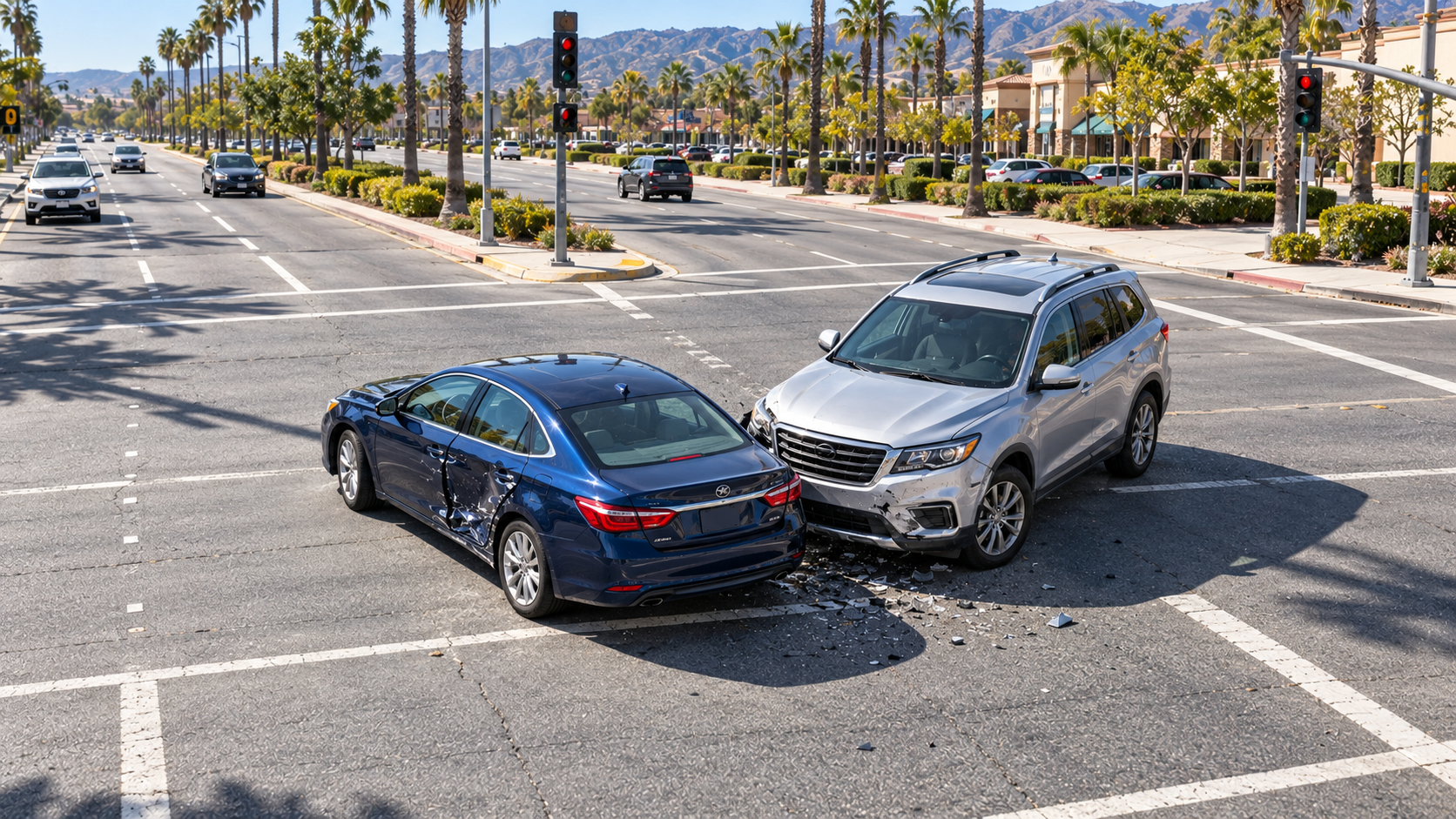
Left-turn crashes are some of the most common serious collisions I see. They are also some of the most argued about. The turning driver says the light was in their favor. The other driver says the turning car came out of nowhere. Both people are usually sure they were right.
Before I started The Mason Law Firm, I spent nearly a decade on the other side of these cases, defending insurance companies. I can tell you the first question an adjuster asks in a left-turn crash: who was turning? Many people think that answer decides the whole case. It doesn’t.
In this post, I’ll walk through two left turns that drivers make every day. One is right here in Valencia, at The Old Road and Magic Mountain Parkway. The other is over the hill in Sherman Oaks, at Ventura Boulevard and Van Nuys Boulevard. It’s the same basic move at both corners, but the rules, and the fault, can come out very differently.
The Basic Rule: The Left-Turning Driver Usually Has to Wait
California Vehicle Code Section 21801 says “a driver turning left must yield to oncoming cars that are close enough to be a hazard. The driver has to keep yielding until it is reasonably safe to finish the turn.” In plain English: if a car coming toward you is close enough that you might hit it, you wait.
There’s a second part of that law that people forget. “Once the turning driver has yielded and signaled, oncoming drivers must then yield to the turning car.” The duty runs both ways.
However, a different rule kicks in when you have a green arrow. Vehicle Code Section 21451 says a driver facing a green arrow may make the turn the arrow shows. Even then, the driver still has to yield to other traffic and to pedestrians lawfully in the intersection or crosswalk.
That difference, a green arrow versus a plain green light, changes almost everything about who is at fault.
Scenario 1: The Old Road onto Magic Mountain Parkway (Protected Green Arrow)
Picture a busy Saturday afternoon in Santa Clarita. You’re on The Old Road near Six Flags Magic Mountain, where park visitors, freeway traffic and local drivers all mix together. You’re in the left-turn lane, waiting to turn onto Magic Mountain Parkway.
The signal gives you a green arrow, so you go. Halfway through your turn, a pickup coming the other way on The Old Road runs its red light and slams into your passenger side.
Who is at fault? In most cases like this, it is the driver who ran the red light. When you have a protected green arrow, you have a right-of-way and oncoming traffic is supposed to stop.
But “usually” is not “always.” A green arrow is not permission to stop paying attention. The turning driver can still share the blame if:
- The arrow had already turned red when they entered the intersection.
- They hit a pedestrian or bicyclist who was lawfully in the crosswalk.
- They saw the pickup coming, had time to stop, and kept going anyway.
- They were on their phone, taking the turn too fast, or swinging wide into the wrong lane.
The Real Fight Is Over the Light
In green-arrow cases, the argument is almost never about the law. It’s about the color of the light. The other driver will often swear their light was green, and it becomes one person’s word against another’s.
That’s why evidence matters so much at a corner this busy. There may be dashcam video, security cameras at nearby businesses, and plenty of witnesses headed to or from the park. The signal’s timing records, which show how long each arrow and light stays green, yellow and red, can also be requested. Video gets erased quickly, sometimes within days, so it needs to be saved early.
Scenario 2: Ventura Boulevard onto Van Nuys Boulevard (No Arrow)
Now let’s head over the hill to Sherman Oaks. Ventura Boulevard and Van Nuys Boulevard is one of the busiest corners in the San Fernando Valley. There are restaurants, shops, buses, people walking, and drivers who are all in a hurry.
In this example, you’re on Ventura and want to turn left onto Van Nuys. This time there’s no arrow. You have a plain green light, and so does the oncoming traffic on Ventura. You pull into the intersection and wait for a gap.
Traffic is heavy. A driver in the closest oncoming lane stops and waves you through. You start your turn. A car in the next lane over, hidden behind the driver who waved, keeps going and hits you. This is a typical scenario.
Who is at fault? This time, the turning driver is in a much tougher spot. Under Section 21801, you had to yield to every oncoming car close enough to be a hazard, not just the ones you could see. A friendly wave from one driver doesn’t clear the other lanes. Insurance companies know this rule well, and they lean on it hard.
But the turning driver is not automatically 100% at fault. The oncoming driver can share the blame if they:
- Were going well over the speed limit, closing a gap faster than anyone could reasonably expect.
- Ran a red light.
- Were looking at their phone instead of the road.
- Sped past a line of stopped cars without slowing down, even though stopped traffic is a warning that something is happening ahead.
When the Light Changes in the Middle of Your Turn
Here’s another common situation at corners like this one. You pull into the intersection on a green, wait for a gap that never comes, and the light turns yellow, then red. You finish your turn as oncoming traffic stops.
That’s normal, and it’s how you’re expected to clear the intersection. If you entered lawfully on the green, you are generally allowed to finish the turn. Drivers on the cross street who just got their green still have to yield to cars lawfully in the intersection. A driver who jumps their green and hits you may be the one at fault.
How California Splits the Blame
California uses a rule called pure comparative fault, which comes from a 1975 California Supreme Court case, Li v. Yellow Cab Co. Each driver gets a percentage of the blame, and your recovery is reduced by your share.
Here’s how that works with simple numbers. Say your damages are $100,000 and you’re found 30% at fault. You can still recover $70,000. Even if you were 80% at fault, you could still recover 20% from the other driver.
This matters a lot in left-turn cases. When I defended insurance companies, the goal was to push as much of that percentage onto the other driver as possible, because every point is money. If an adjuster can convince you the crash was “all your fault because you were turning,” they may never pay what the claim is really worth.
Evidence That Moves the Percentages
| Evidence | What it can show |
|---|---|
| Dashcam, store and doorbell video | The color of the light, who entered first, how fast each car was going |
| Vehicle “black box” data | Speed and braking in the seconds before impact |
| Where the cars were damaged | The angle of the crash and how far the turn had gotten |
| Witness statements | The light, the speed, and whether anyone waved the turning driver through |
| Signal timing records | The arrow and light sequence at that intersection |
| Police report | A starting point, but not the final word on fault |
What to Do After a Left-Turn Crash
1. Get medical care. Call 911 if anyone is hurt, and see a doctor even if you feel okay. Some injuries show up days later.
2. Photograph everything. Take pictures of both cars, the traffic signal, the lane markings and the whole intersection.
3. Get witness information. Names and phone numbers matter, especially at busy corners where people leave quickly.
4. Don’t guess or apologize. Don’t admit fault or estimate speeds at the scene. Stick to the facts.
5. Be careful with the other driver’s insurance company. Don’t give a recorded statement before you talk with a lawyer.
6. Know your deadline. Most injury claims in California must be filed within two years. If a government vehicle or road is involved, you may have only six months to file a claim.
The Bottom Line
A green arrow at The Old Road and Magic Mountain Parkway and a plain green light at Ventura and Van Nuys may look like the same turn. But, legally, they can be very different cases. Being the turning driver does not automatically mean you’re at fault, and being hit by one doesn’t mean the case is simple.
Whether your crash happened in Santa Clarita, Valencia, Canyon Country, Newhall, Saugus, Stevenson Ranch, Castaic, Val Verde, Antelope Valley, Palmdale, Lancaster, or anywhere in the San Fernando Valley, the questions are the same:
- Who had the light?
- Who could have avoided it?
- What does the evidence actually show?
I spent years helping insurance companies answer those questions in their favor. Now I use that experience for injured people across Los Angeles, Ventura and Kern Counties.
We offer free consultations and work on a contingency fee basis, meaning you pay nothing unless we win your case.
📞 Call 661-506-2994 for a free consultation.
“We Meet Our Clients by Accident!”
and
“We Put Personal in Personal Injury Law.”
Car accidents, bicycle accidents, bus accidents, motorcycle accidents, pedestrian accidents, truck accidents, slip and falls, dog bites, nursing home abuse cases, burn injuries, construction site accidents, amusement park accidents, brain injuries, spinal cord injuries, wrongful death cases, ride share accidents
Santa Clarita Valley Chamber, Greater San Fernando Valley Chamber, Santa Clarita Bar Association, San Fernando Valley Bar Association, Better Business Bureau, State Bar of California, Justia, avvo, Lexinter Law, linkedin, findlaw, Instagram, Tiktok, Facebook, Youtube, experience.com, TEAM referral network, Cornell Law School, USAttorneys.
Home page, testimonials, blogs, videos, awards, Mason Rashtian, Vision Statement, Facts and questions, contact page.